
Llamas, alpacas, vicuñas, and guanacos are an essential part of the landscapes and culture of the Peruvian Andes. In this blog, you’ll learn how to tell these four camelid species apart, explore their history, and find out where you can see them during your trip to Peru. From Cusco to Colca Canyon, there are several places where you can encounter these animals in different natural and cultural settings. We’ll also show you how to enjoy a close and respectful encounter with them while traveling responsibly.
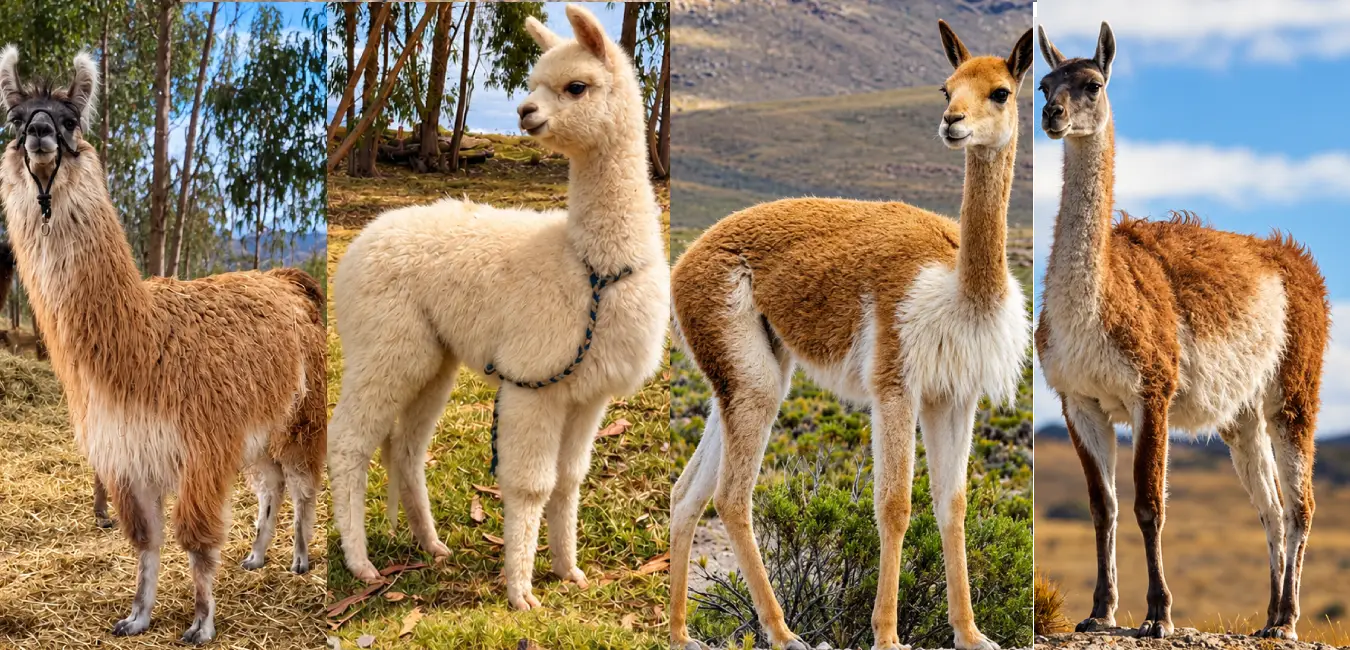
What is the difference between a Llama, Alpaca, Vicuña, and Guanaco?
Here we show you the differences between these four species of South American camelids.
- Llama: traditionally used as a pack animal.
- Alpaca: primarily raised for its fiber.
- Vicuña: famous for its exceptionally fine fiber.
- Guanaco: has a small population in Peru and is difficult to spot.
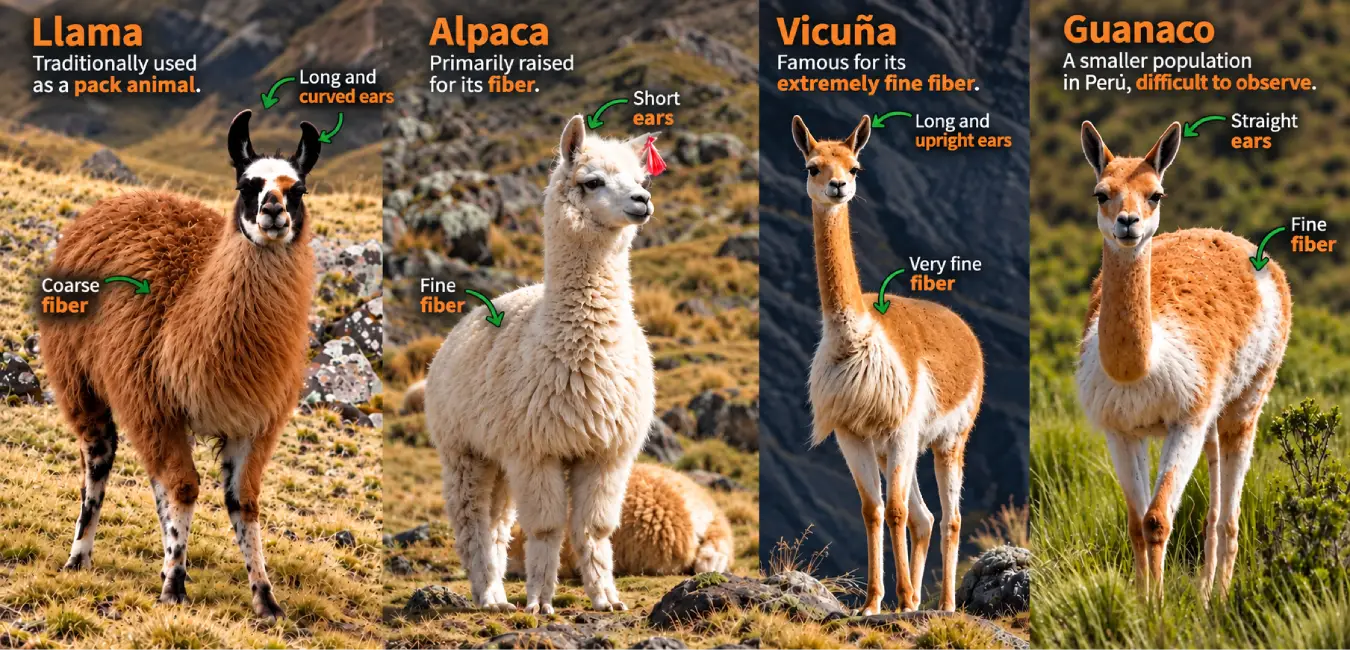
Comparison table of Llamas, Alpacas, Vicuñas, and Guanacos.
Characteristic | Llama | Alpaca | Vicuña | Guanaco |
|---|---|---|---|---|
| Status | Domesticated | Domesticated | Wild | Wild |
| Size | Large (up to 200 kg) | Medium (45 to 90 kg) | Small (35 to 50 kg) | Large (90 to 140 kg) |
| Ears | Long and curved | Short | Long and upright | Straight |
| Fiber | Coarse | Fine | Very fine | Fine |
| Main use | Pack animal | Fiber | Fiber | Conservation |
| Habitat | Andes | Andes | Puna | Arid areas |
What are south American camelids?
Llamas, Alpacas, Vicuñas, and Guanacos make up the group of South American camelids, also known as “auquénidos,” a term that comes from the Greek auchén, meaning “neck.” They are related to camels and dromedaries, although they do not have humps. They inhabit the Andes of Peru, Bolivia, Chile, Argentina, and Ecuador.
Important fact…
Science groups them into two genera. On one hand, the Lama genus includes the Llama and Guanaco; on the other, the Vicugna genus includes the Alpaca and Vicuña. In addition, each domesticated species descended from a wild species.
Species | Scientific name | Status | Descended from: |
|---|---|---|---|
| Llama | Lama glama | Domesticated | Guanaco |
| Guanaco | Lama guanicoe | Wild | — |
| Alpaca | Vicugna pacos | Domesticated | Vicuña |
| Vicuña | Vicugna vicugna | Wild | — |
How to tell Llamas, Alpacas, Vicuñas, and Guanacos apart
Here we show you how to tell these four species apart like a true Peruvian, by paying attention to small details that will help you recognize them at a glance during your trip through the Andes.
How to tell if it is a Llama
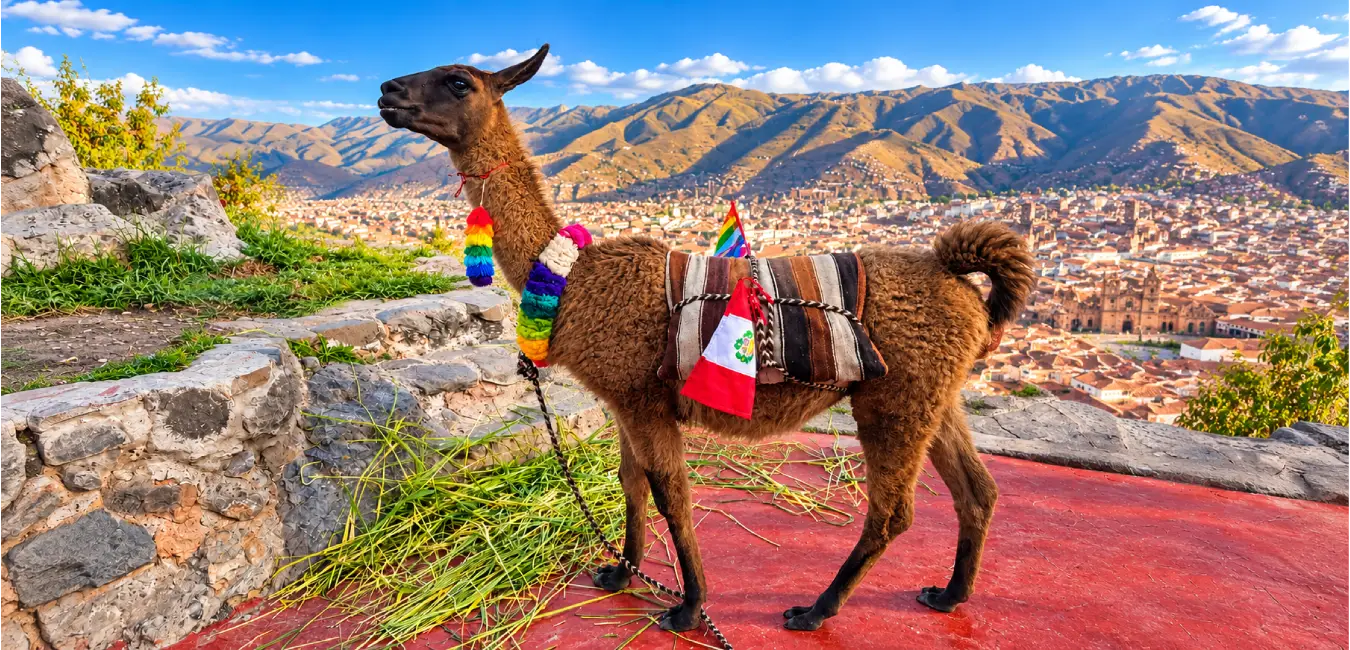
- Ears are long and curved inward, with a banana like shape. This is the most reliable clue.
- Body is tall with a clear face and less wool on the face than an Alpaca.
- It often carries a load or has colorful pom poms on its ears. Shepherds sew them on during the herd marking ceremony.
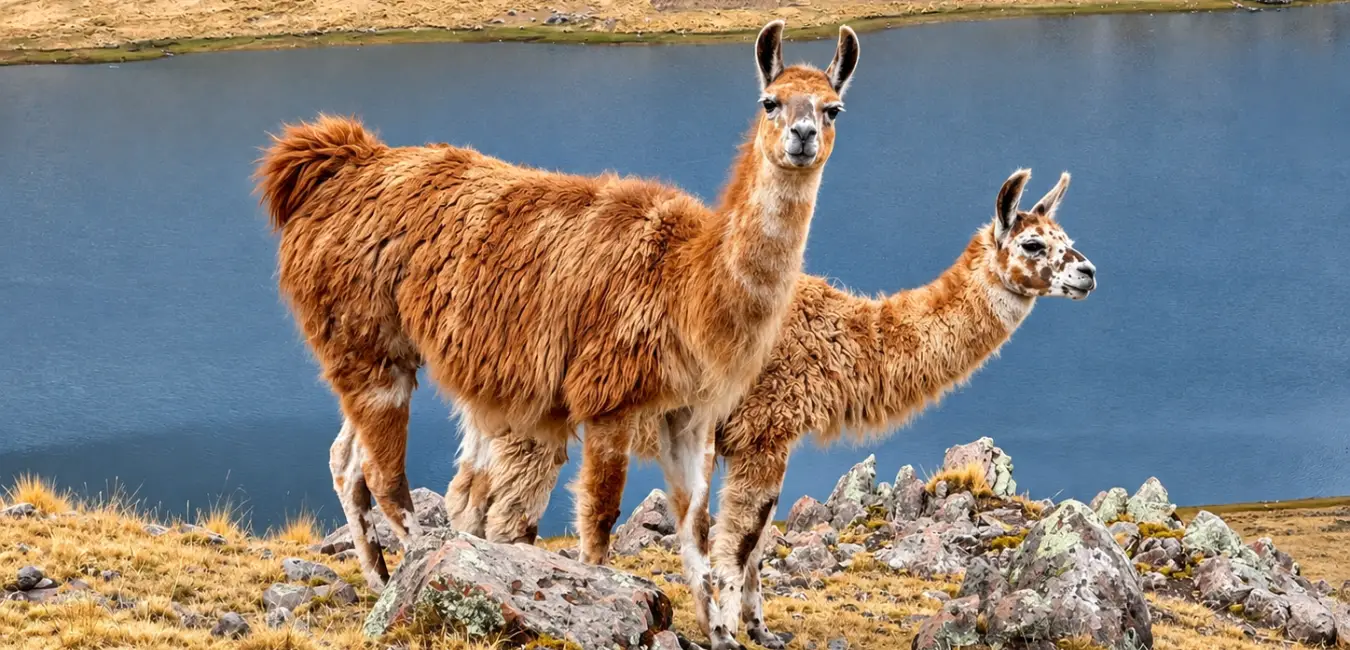
There are two types of Llamas:
- The q'ara, with short hair and preferred for carrying loads
- The ch'aku, with a heavier coat.
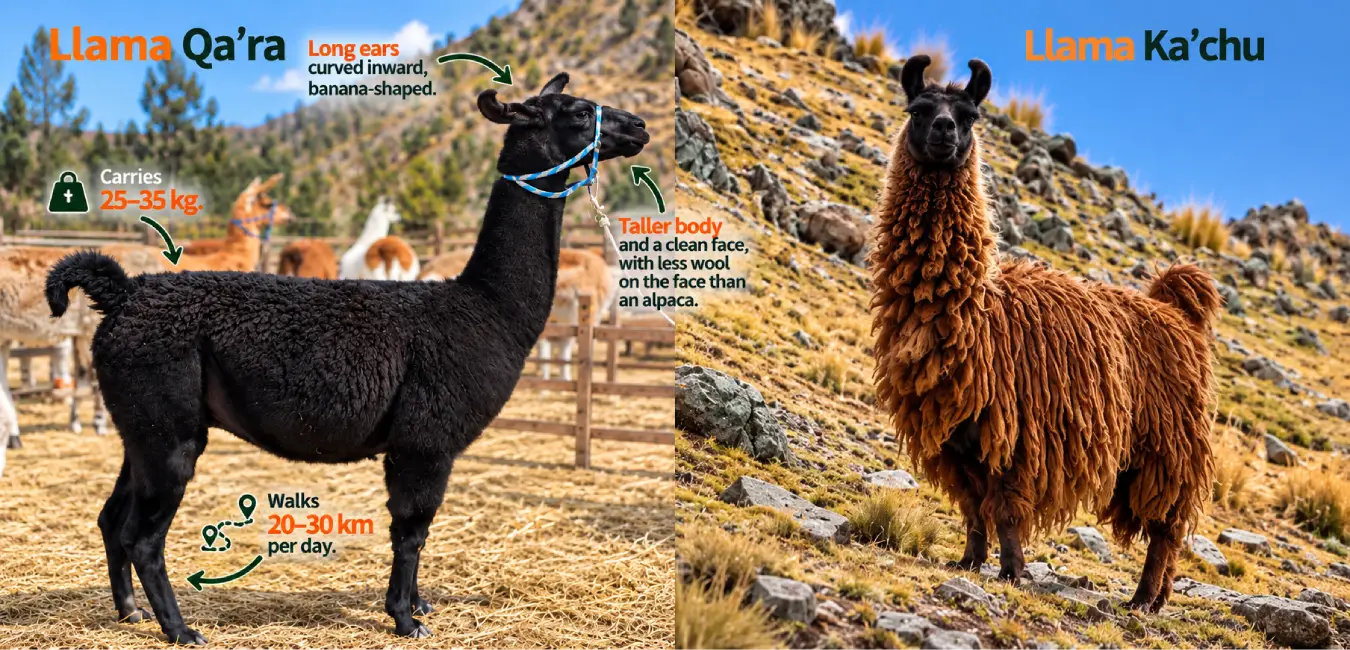
How much weight can a Llama carry?
A Llama can carry between 25 and 35 kilograms, about one quarter of its body weight, and walks between 20 and 30 kilometers a day; if it is overloaded, it will lie down and refuse to move. Because of its brave nature, many families also use llamas to protect their sheep from foxes.
How to tell if it is an Alpaca
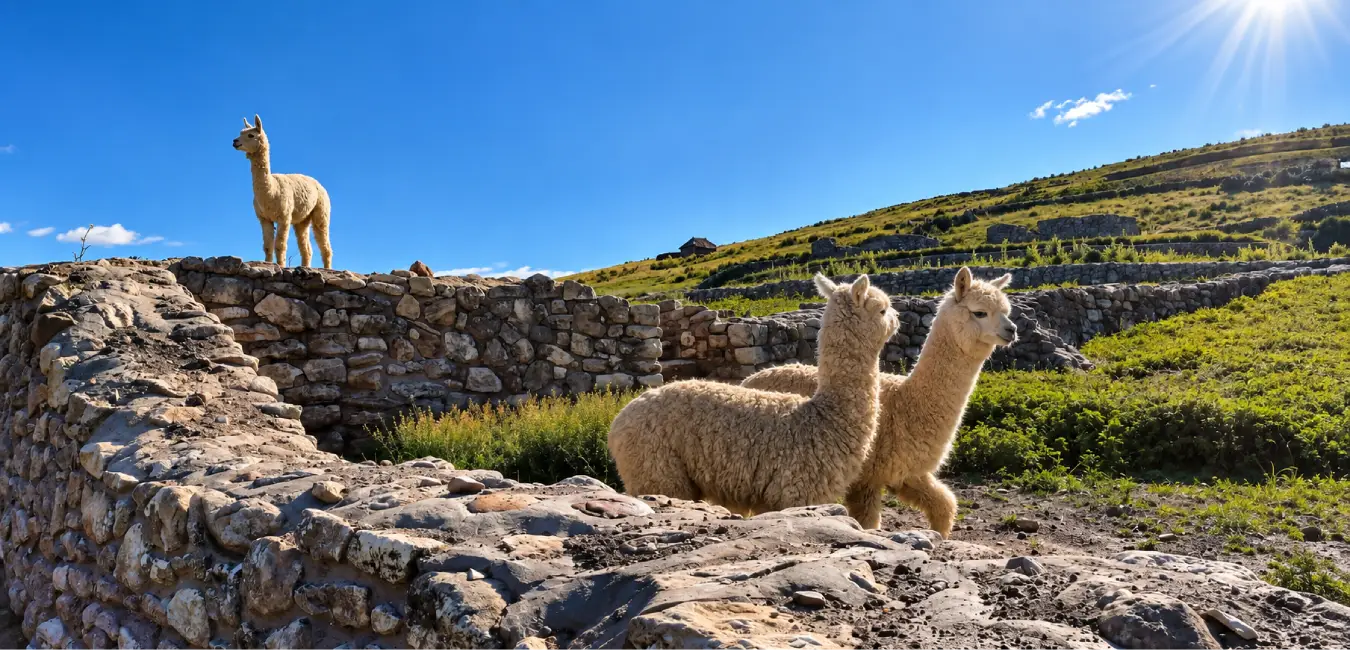
- Ears are short and straight, shaped like a spearhead.
- Body is compact and rounded, with abundant wool that even covers its forehead.
- It grazes in large herds in bofedales, the wetland areas of the puna where it finds tender grasses.
There are two Alpaca breeds:
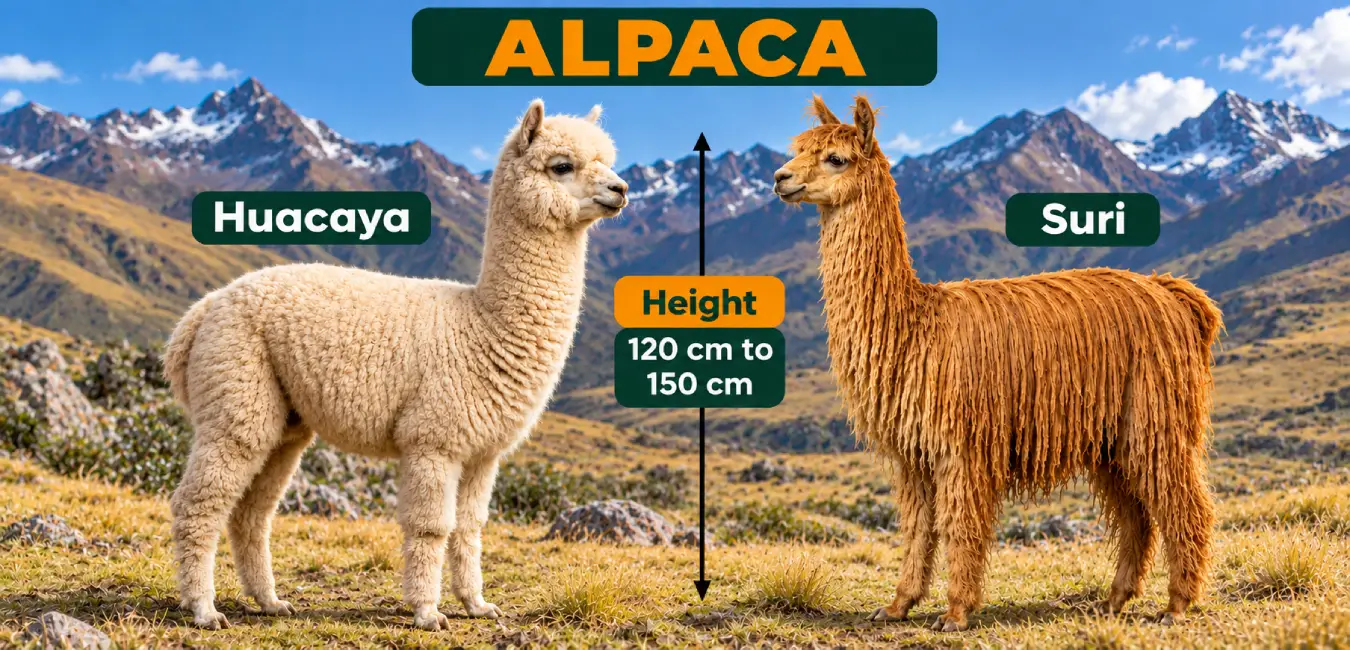
- The huacaya, with fluffy, curly wool, which you will see in almost every herd.
- The suri, with long, silky fiber that falls in locks. Its fiber provides excellent warmth because it is hollow inside and contains tiny air pockets; it also contains no lanolin, so it is rarely itchy. Peru exports alpaca clothing and fiber around the world.
Fun fact...
All four species can interbreed and produce fertile offspring. For example, shepherds call the cross between a llama and an alpaca a "huarizo."
What is a Vicuña?
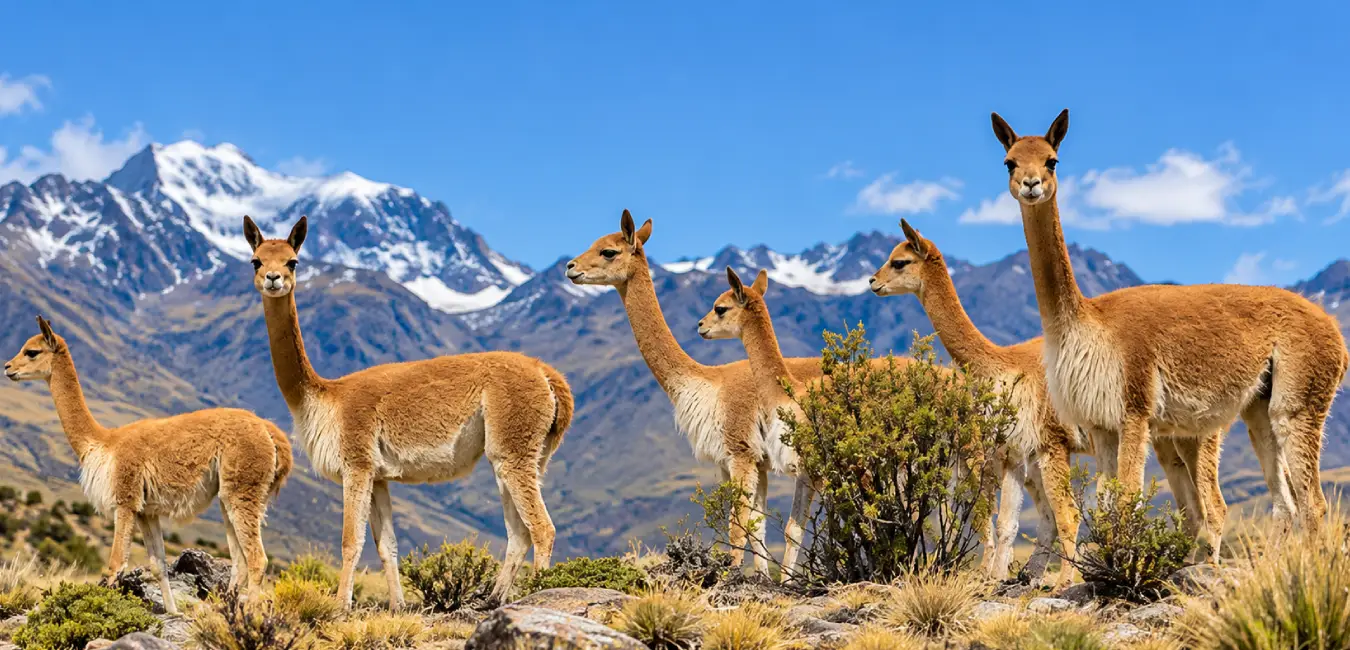
The Vicuña is a wild camelid of the Andean puna and the national animal of Peru. It produces the finest animal fiber in the world; however, each animal yields only about 200 grams, and communities shear them every two or three years. That is why an authentic garment can cost thousands of dollars.
Vicuña protection in Peru
Since 1995, Law No. 26496 has regulated their use: rural communities may use the fiber of vicuñas found on their lands as long as they shear them while they are alive and then release them. The vicuña also appears on Peru's national coat of arms and has its own day, November 15.
What is a Guanaco?
The Guanaco is the largest wild camelid in South America and the species with the widest distribution, ranging from the Peruvian Andes to Tierra del Fuego. However, only a few scattered groups survive in Peru, so seeing one is exceptional. You can recognize it by its deep brown back, white belly, and grayish face.
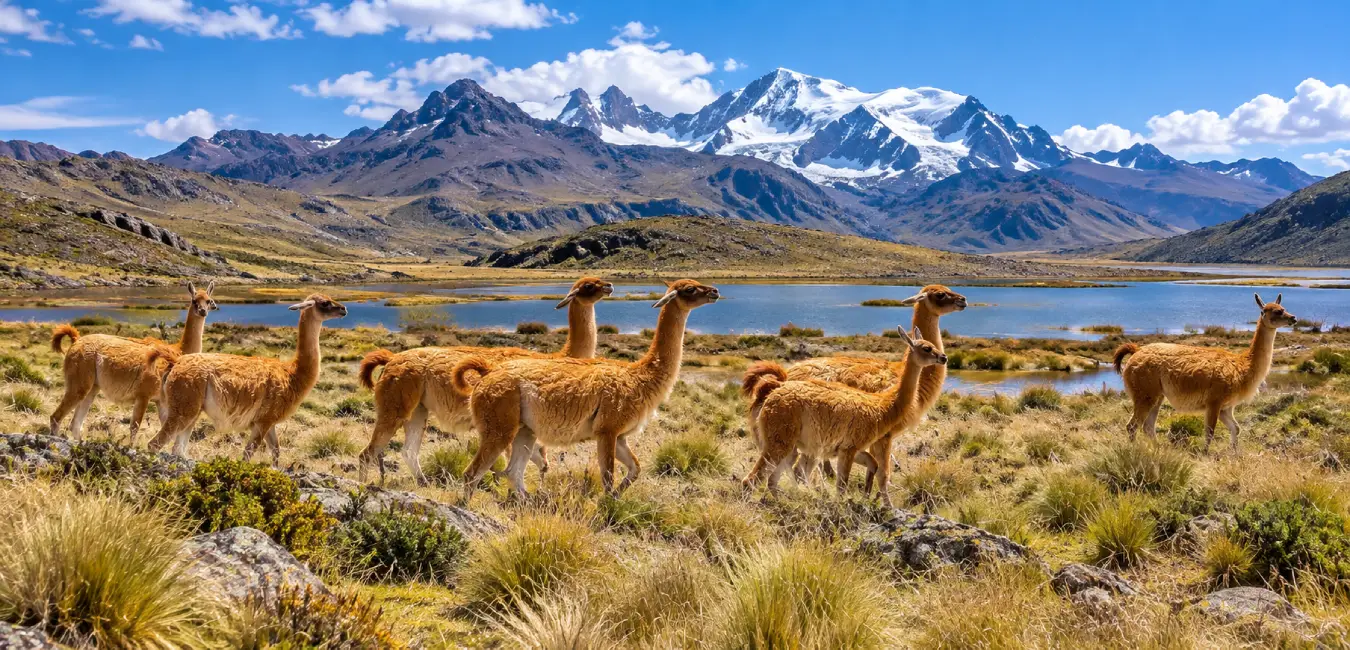
Llama vs. Alpaca
The Llama and Alpaca are the two domesticated species and therefore the ones people most often confuse. Both live in herds alongside high Andean communities; however, they serve different purposes.
Characteristics | Llama | Alpaca |
|---|---|---|
| Size | Larger and can weigh twice as much as an alpaca. | Smaller and lighter. |
| Traditional use | Mainly as a pack animal. | Mainly for its fiber. |
| Face | Long, clear face. | Shorter face covered with wool. |
| Temperament | Usually confident and curious. | Generally shy and gentle. |
| Main characteristic | Strength and ability to carry loads. | Highly valuable fiber for the textile industry. |
A common misconception worth clearing up...
An Alpaca is not a baby llama. They are different species: the llama descended from the Guanaco, while the Alpaca descended from the Vicuña.
Vicuña vs. Guanaco
The Vicuña and Guanaco are the two wild species. Neither lives in domesticated herds, so you will only see them in the puna or protected areas. Even so, you can easily tell them apart by their size and by how common they are in the country.
| Vicuña | Guanaco |
|---|---|---|
| Size | Smaller | Larger |
| Status | Wild and protected | Wild and endangered in Peru |
| Appearance | Slender, cinnamon-colored, white chest | Robust, deep brown back, gray face |
| Distribution in Peru | Widespread | Very limited |
| Fiber | Extremely fine (12 to 13 microns) | Fine (14 to 18 microns) |
| Where to look for them | Puna and protected areas | Specific protected areas |
Where to see Llamas, Alpacas, Vicuñas, and Guanacos in Peru
Before you plan your trip, keep in mind that almost all the places in this section are above 3,800 meters; therefore, it is best to acclimatize for one or two days in Cusco or Arequipa before heading higher.
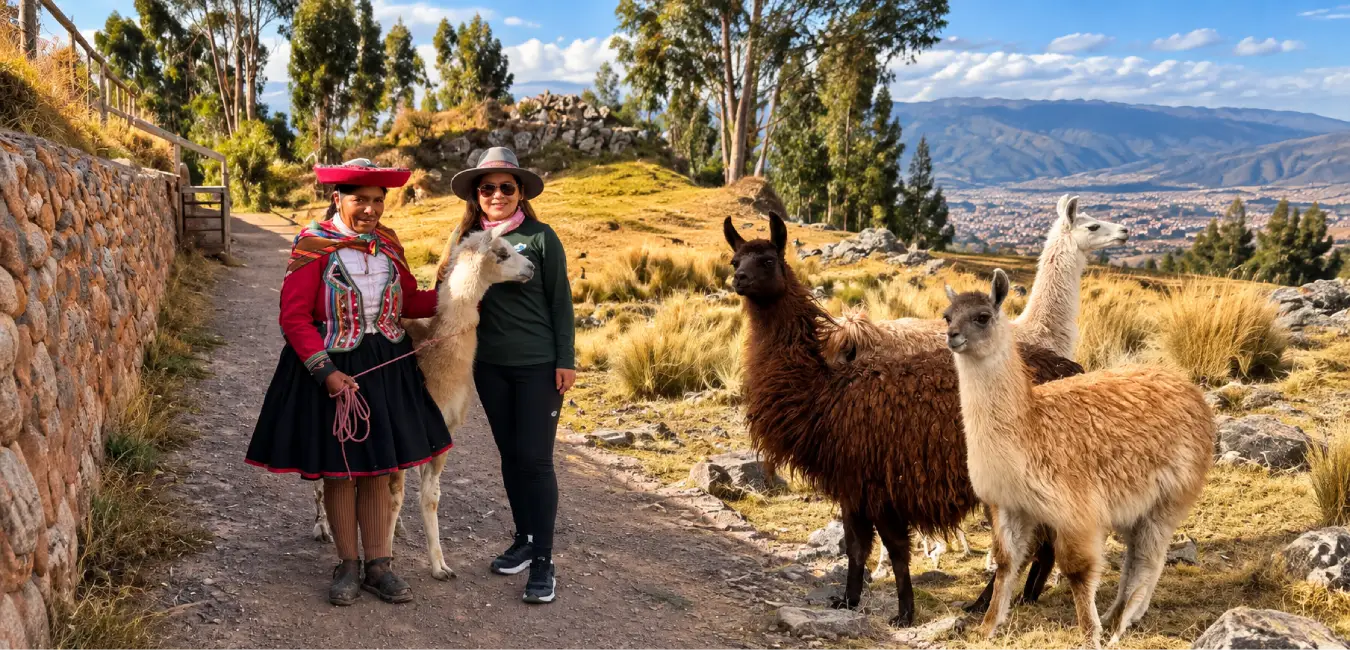
Where to see Llamas in Cusco
- If you want to see llamas easily: downtown Cusco, the Coricancha-Huchuy Qosqo route, Sacsayhuamán, or Awanakancha.
- If you want to see alpacas: along the Coricancha-Huchuy Qosqo route, in the Puno highlands, at Awanakancha, or in Chinchero.
- If you want to see wild vicuñas: Pampa Cañahuas (on the way to Colca) or Pampa Galeras.
- If you want to see guanacos: Calipuy National Reserve.
- If you want to hike alongside llamas: the Coricancha to Huchuy Qosqo - Machu Picchu route. Here, you do not just see them: you walk with them. We tell you more about the experience below.
Which species can you find at each destination?
Destination | Llama | Alpaca | Vicuña | Guanaco |
|---|---|---|---|---|
| Cusco (city) | X | X | ||
| Coricancha to Huchuy Qosqo - Machu Picchu | X | X | ||
| Machu Picchu | X | |||
| Awanakancha | X | X | X | X |
| Vinicunca | X | X | ||
| Palcoyo | X | X | ||
| Pampa Cañahuas | X | X | X | |
Puno | X | X | X |
Where to see Alpacas in Cusco and Puno
- Coricancha - Huchuy Qosqo - Machu Picchu hike. Here, you will enjoy their company along the Inca Trail, walk alongside them, and take photos without any problem.
- Awanakancha. It brings together all four species, so you can compare them up close and see how the weavers dye and weave the fiber.
- Chinchero. At its textile centers, artisans wash the wool with sacha paraqay root, dye it with plants and cochineal, and weave it on a loom.
- Rainbow Mountain and Palcoyo. Along the puna sections, shepherds take their herds out to graze, especially in the morning.
- Puno Highlands. Puno leads the country in alpaca farming. Between Cusco and Puno, especially when crossing La Raya Pass, you will see large herds accompanying you all the way to Lake Titicaca.
Where to see Vicuñas, Alpacas, Llamas, and Guanacos in the Wild
Place | Region | What you can see | Key fact |
|---|---|---|---|
| Pampa Cañahuas – Salinas and Aguada Blanca National Reserve. | Arequipa | Vicuñas, alpacas, and llamas. | One of the most accessible places to see vicuñas, at around 4,000 m (13,123 ft). |
| Pampa Galeras Bárbara D'Achille National Reserve. | Ayacucho | Vicuñas | A protected area dedicated to vicuña conservation. |
| Nor Yauyos Cochas Landscape Reserve. | Lima | Vicuñas | Vicuñas are part of the high Andean wildlife found in the reserve. |
| Chacamarca Historic Sanctuary. | Junín | Vicuñas | You can find vicuñas in the sanctuary's high-Andean landscapes. |
| Huascarán National Park | Áncash | Vicuñas | Vicuñas are part of the wildlife found in the park's high Andean areas. |
| Calipuy National Reserve | La Libertad | Guanacos | One of the main refuges for guanacos in Peru, although they are difficult to spot. |
How to get to the best places to see Llamas, Alpacas, Vicuñas, and Guanacos
Most places in Cusco are just a short drive from the city or are included as part of a tour. However, these three destinations require a little more planning:
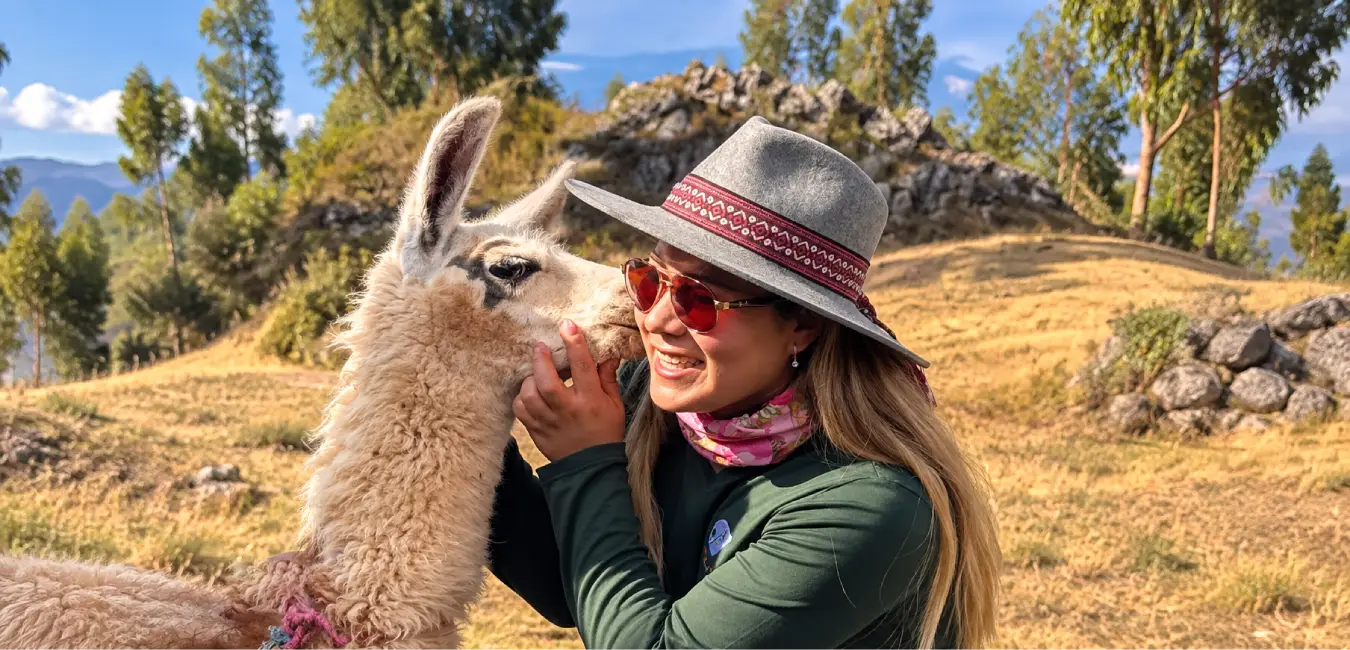
Four places to see Llamas, Alpacas, Vicuñas, and Guanacos
Coricancha-Huchuy Qosqo-Machu Picchu.
This route created by Responsible Trekking connects Coricancha, Cusco's Plaza de Armas, Sacsayhuaman, Ñusta pakana, Huchuy Qosqo, and Machu Picchu in a unique experience where llamas become part of the journey and the Andes become your backdrop. As evening falls, you will rest in our mountain domes. You choose when to travel and what you want to experience; we take care of adapting the route to your schedule and creating an experience with you that truly feels like your own. Write to us and let's start planning it.
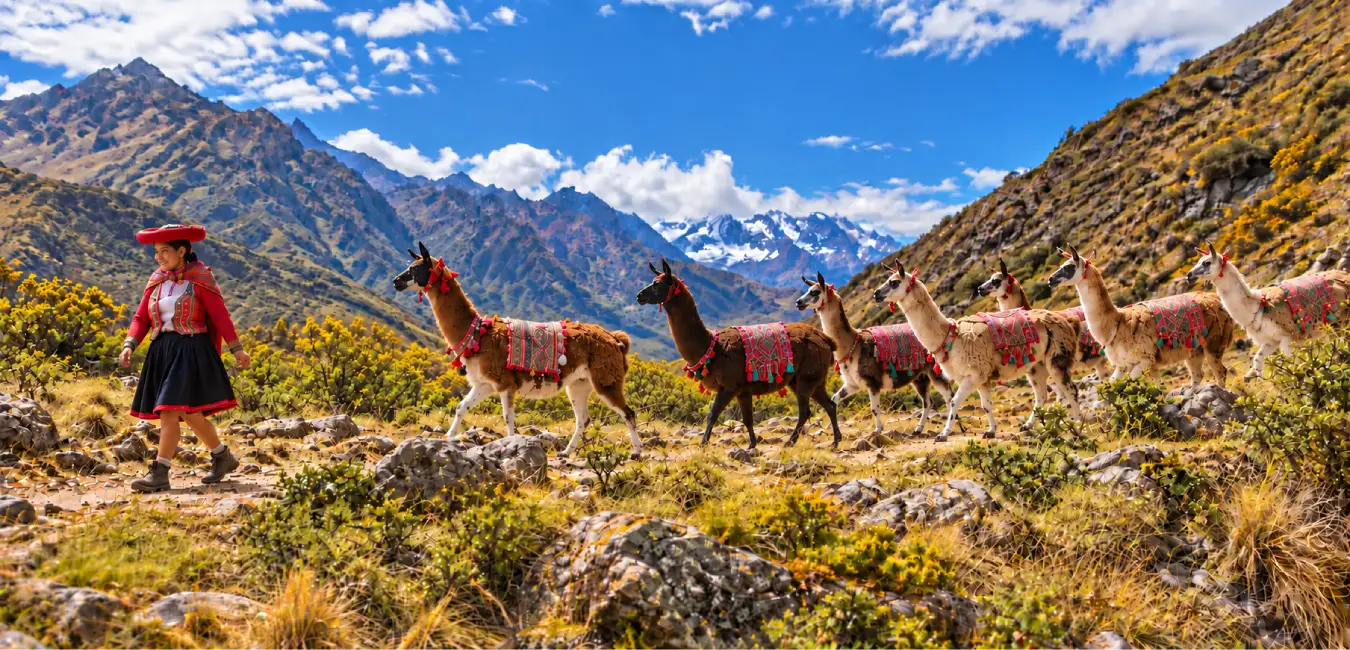
Awanakancha
Awanakancha is located along the Cusco-Pisac road, about 40 minutes from downtown Cusco. You can get there by taxi or by taking a shared minibus heading to Pisac and asking the driver to drop you off at the entrance. Many Sacred Valley tours also include a stop here. There is usually no fixed admission fee, although a tip or a purchase at the textile shop is appreciated.
Pampa Cañahuas
Pampa Cañahuas is located along the paved road connecting Arequipa with Chivay, about 2 hours from Arequipa city. The most practical way to visit is on a tour to the Colca Canyon, as almost all tours stop here to see vicuñas. If you are traveling independently, keep in mind that public buses to Chivay do not make tourist stops.
Pampa Galeras
The Pampa Galeras Bárbara D'Achille National Reserve is located in Lucanas, Ayacucho, along the road from Nasca to Puquio, about 2 hours from Nasca. For this reason, you can combine it with a visit to the Nazca Lines. If you want to witness the Chaccu, confirm the date in advance with the municipality of Lucanas or with SERNANP.
What is the best time of year to see Llamas, Alpacas, Vicuñas, and Guanacos?
You can see camelids year-round; however, each season offers something different:
Dry season (May to October)
Clear skies and firm trails make hiking and photography easier, especially on high-altitude routes.
Rainy season (December to March)
The grasslands turn green and most young are born, so you will see herds with newborn animals. However, some trails become muddy.
Special dates
Between May and November, several communities hold the “Chaccu de vicuñas,” or vicuña roundup; the best-known one takes place in late June at Pampa Galeras. Meanwhile, “señalakuy,” the herd-marking ceremony, usually coincides with Carnival, June, or August 1, depending on the community.
Where can you walk with Llamas in Cusco?
At Responsible Trekking, we travel the route from Coricancha, Cusco's Plaza de Armas, Sacsayhuaman, Ñustapakana, Huchuy Qosqo, and Machu Picchu, accompanied by llamas. The journey begins at the ancient Temple of the Sun in downtown Cusco and continues along ancient sections of the Inca Trail into the mountains, where we take a break in our domes before descending toward Huchuy Qosqo, the “little Cusco” spread across the Sacred Valley.
Where does it start?
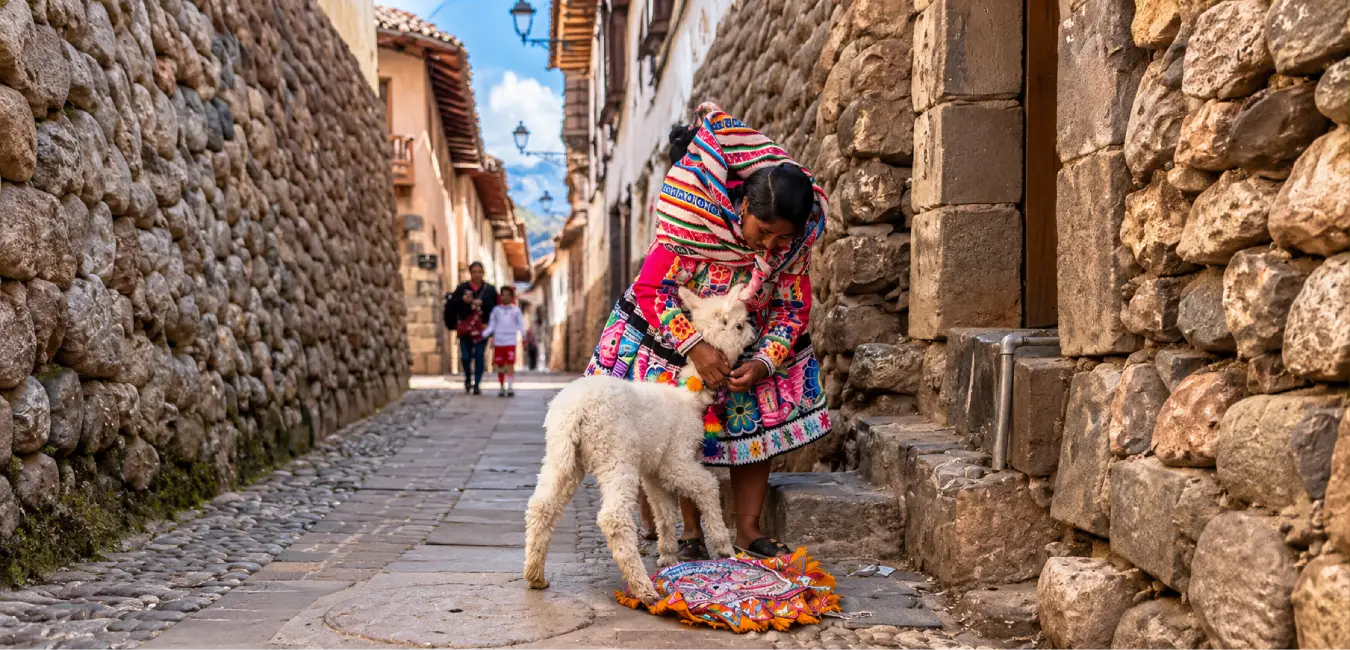
The adventure begins in Llaullipata, an ancient section of the Inca Trail within Sacsayhuamán. There, the shepherd and our camelids will be waiting to welcome you and begin the journey together toward Huchuy Qosqo. From the very first steps, the landscape begins to change, and the trail gradually leads you out of the city, through mountains, ancient paths, and the company of llamas.
How long does the Llama hike last?
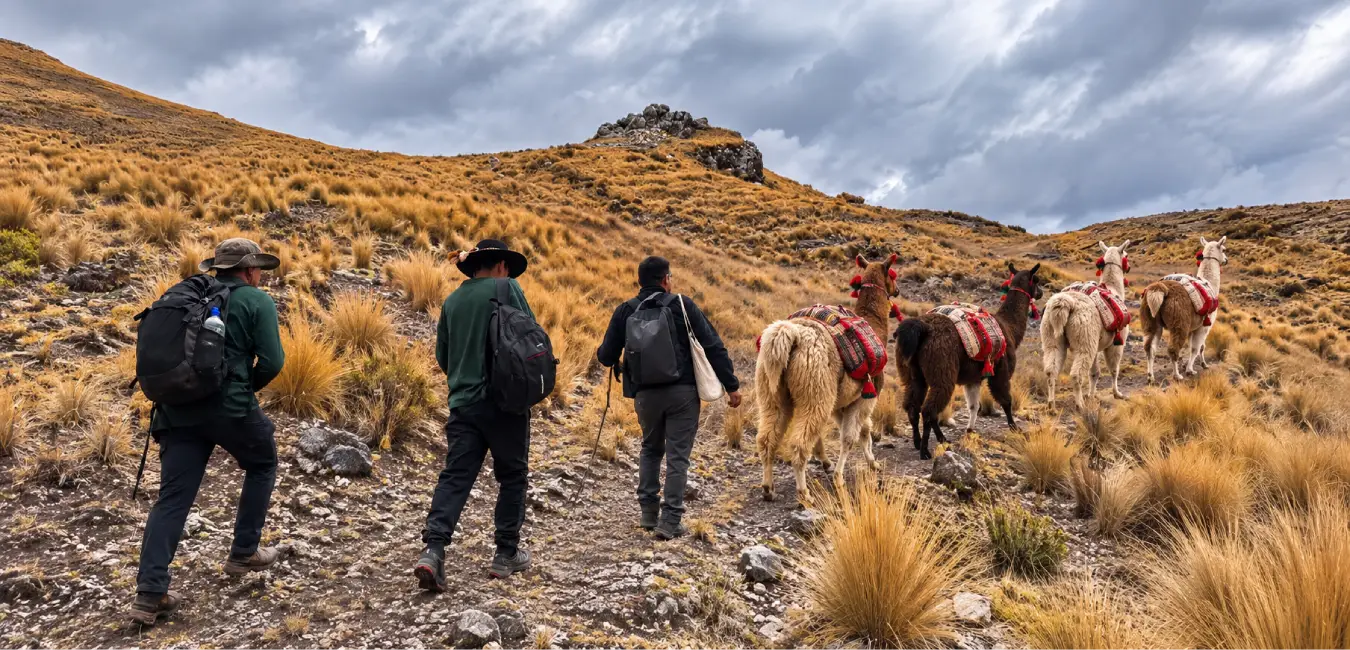
You choose how long you want to experience this adventure and which routes you would like to follow. Along the way, the Llamas and Alpacas will walk with you, allowing you to get to know them up close, learn how to tell them apart, observe them in their daily lives, and, of course, take plenty of great photos with them.
Tours | Route | Duration | Max. altitude | Difficulty | Llamas and Alpacas | Arrival at Machu Picchu | Ideal for |
|---|---|---|---|---|---|---|---|
| Corikancha + Classic Inca Trail. | Corikancha → Ñustapaqana → Andean Sky Dome → Huchuy Qosqo → Ollantaytambo → Km 82. | 6 days. | 4,215 m (13,829 ft). | Moderate to challenging. | Yes | Classic Inca Trail. | Those looking for a complete trekking experience, with rest in Domes. |
| Corikancha + Short Inca Trail. | Corikancha → Ñustapaqana → Andean Sky Dome → Huchuy Qosqo → Ollantaytambo → Km 104. | 4 days | 4,200 m (13,780 ft). | Moderate to challenging. | Yes | Short Inca Trail | Those who want to combine Huchuy Qosqo with the Inca Trail, with rest in Domes. |
| Corikancha + Train. | Corikancha → Ñustapaqana → Andean Sky Dome → Huchuy Qosqo → Sacred Valley → Aguas Calientes. | 3 days | Up to 4,200 m (13,780 ft). | Moderate | Yes | Train + bus | Those who prefer to combine trekking, one night in Domes, and a train ride. |
What landscapes will you cross?
The trail will take you through Queuña forests and native plants of Cusco, six natural lagoons, and inter Andean valleys characteristic of Cusco. It is a journey where the landscape changes with every section, bringing you closer and closer to the Andean wilderness.
How travelers interact with them
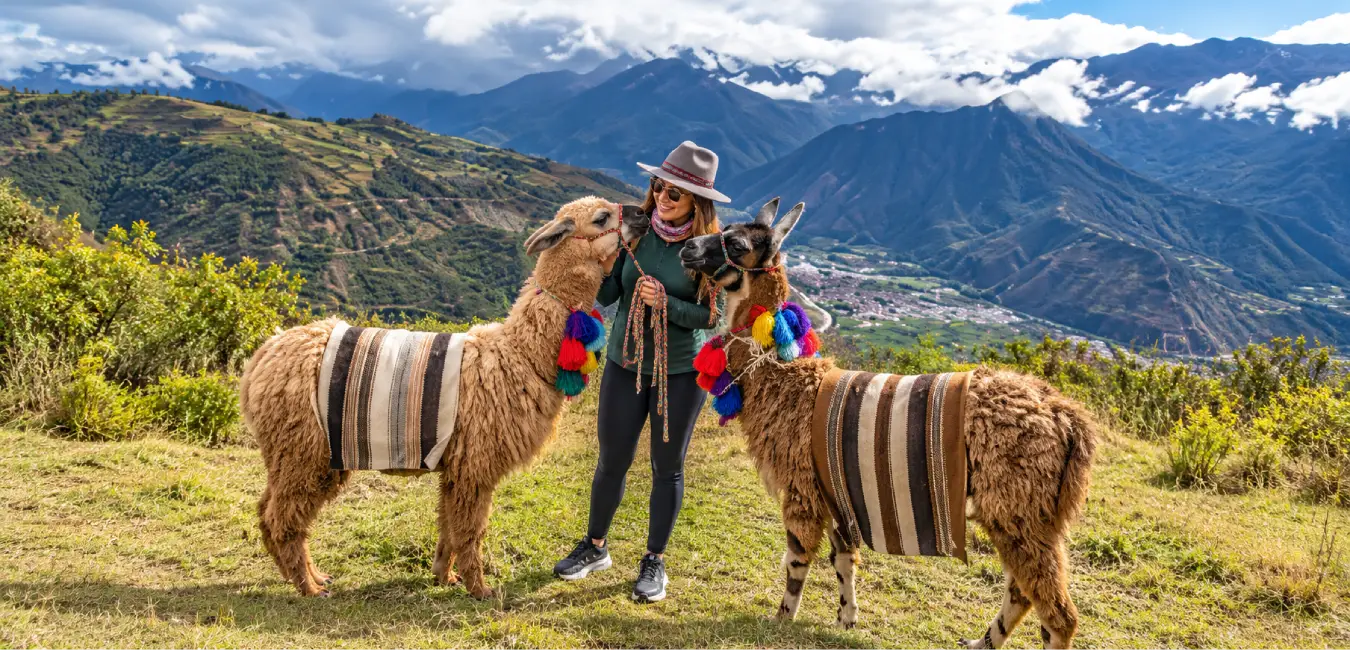
You can walk alongside them, take photos, and, with the llama handler's permission, lead one by its rope along the flatter sections.
- What role do they play? Llamas carry part of the group's equipment, such as backpacks, fruit, water, and first-aid supplies, within the weight limit their bodies can safely tolerate, just as they did in the ancient caravans of the Qhapaq Ñan.
- Who accompanies them? They are guided by a llama handler from the Salkantay community, who knows each animal and decides its pace and rest periods.
- How do they behave? They walk calmly in a line, stop to graze when the group rests, and, if they feel comfortable, allow you to observe them up close.
- What should you do? Always follow the llama handler's instructions and give the animals the right of way on narrow trails.
History of Llamas, Alpacas, Vicuñas, and Guanacos
Origins of camelids
The first camelids appeared in North America about 45 million years ago and were only about 30 centimeters tall. Over time, one branch crossed into Asia and gave rise to camels and dromedaries, while another reached South America about 3 million years ago, when the Isthmus of Panama formed. Eventually, camelids disappeared from North America and survived only in South America.
Domestication of Llamas and Alpacas in Peru
Between 6,000 and 7,000 years ago, communities in the puna of Junín, at more than 4,000 m (13,123 ft) above sea level, began domesticating these animals as they moved away from a nomadic way of life. This gave rise to the Llama and Alpaca, which provided meat, warmth, and transportation. Even their dried manure, known as "taquia," was used as fuel in a puna with few trees and as fertilizer for potato crops.
The Inca Empire
During the Tahuantinsuyo, Llamas, Alpacas, and vicuñas played an important role in the life of the empire, not only because of what they provided but also because of their ceremonial value. Their fiber was used to make "cumbi," one of the finest textiles of the period, while vicuña fiber was reserved for the Inca and the nobility.
Historical fact…
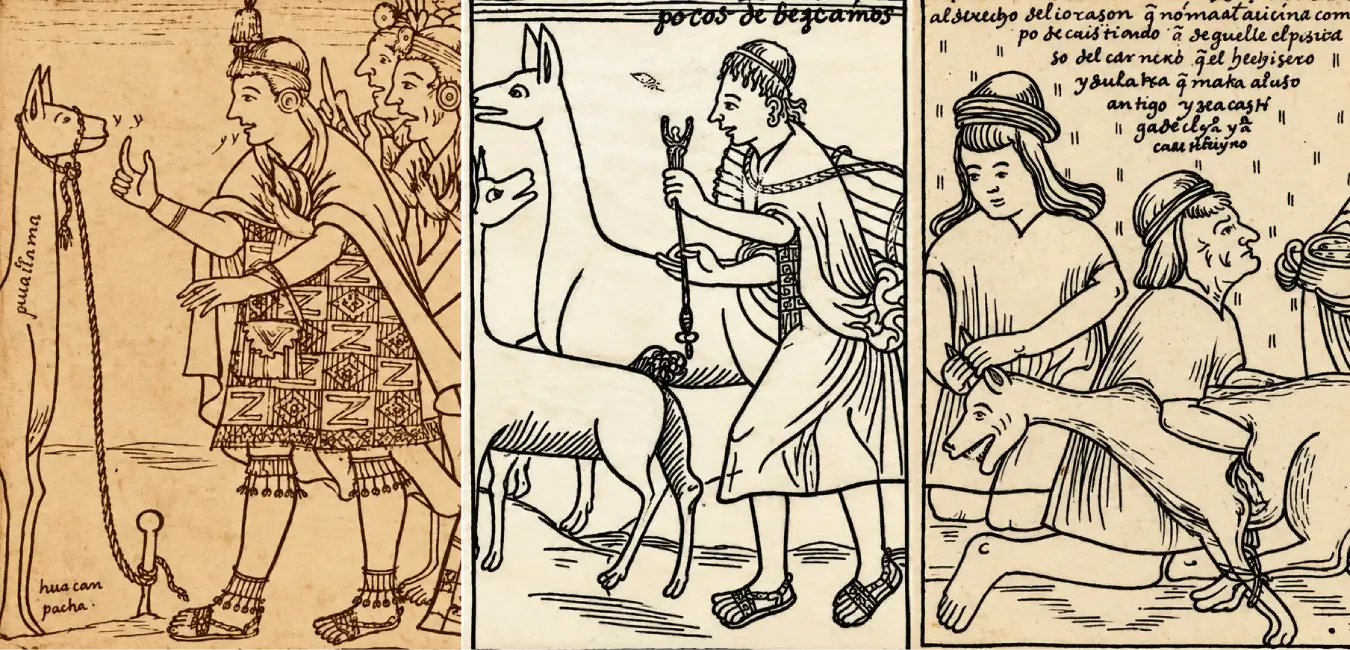
Did you know that the shepherds who cared for the herds during Inca times were known as llama michi and llama camayoc? Their job was to care for Llamas, Alpacas, and other camelids. Every November, officials counted the animals and recorded the information in quipus, the record-keeping systems used throughout the Tahuantinsuyo.
The Sacred Value of Llamas, Alpacas, Vicuñas, and Guanacos to the Incas
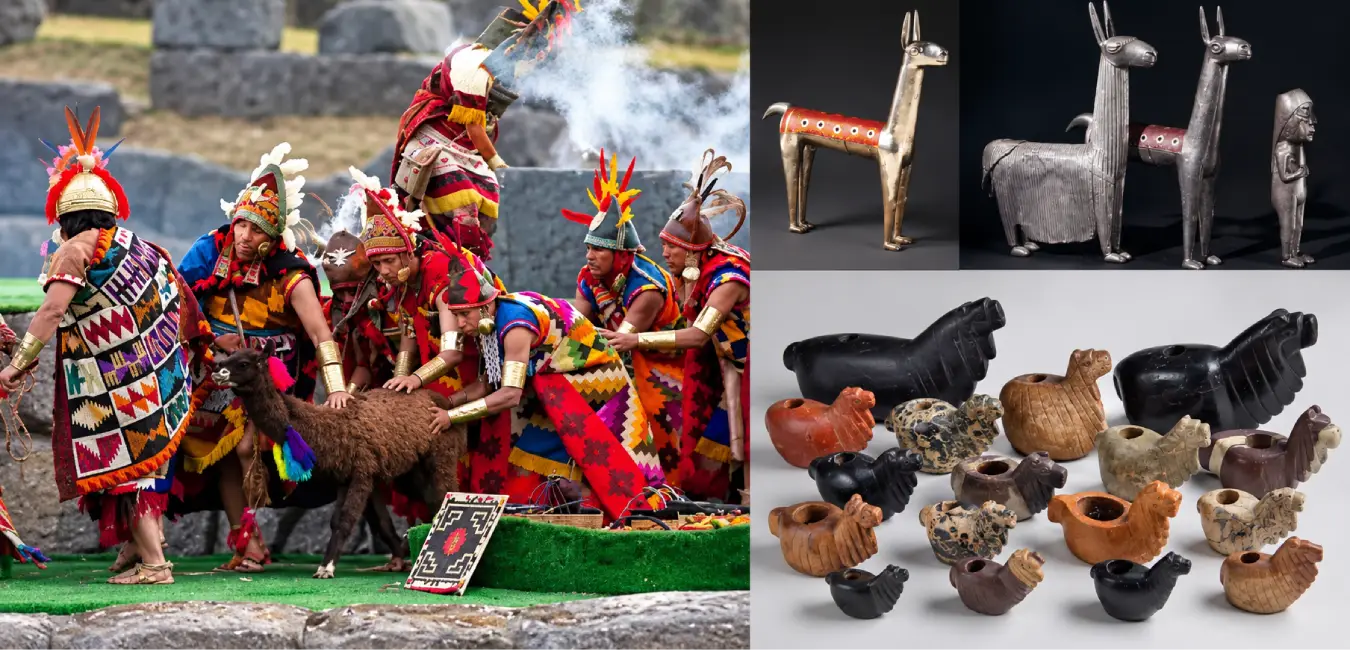
For the Incas, these animals had sacred value. For this reason, they carved small stones in their shape, called "conopas" or "illas," filled them with blood, coca leaves, and chicha, and offered them to Pachamama.
- Likewise, they presented animals as offerings in temples and sanctuaries and represented them in miniatures made of gold and silver to ask the apus for health and prosperity.
- The white Llamas, or “napas,” were adorned with spondylus shells, gold earrings, and embroidered blankets and accompanied the Inca at the front of royal processions.
Llamas in Andean cosmology
For the Incas, Llamas were part of their agricultural rituals: they offered them to protect crops, give thanks for the harvest, and ask for rain. This connection also extended into the sky, where they identified "Yacana," a celestial llama represented by the dark patches of the Milky Way, which you can see on clear nights during the dry season.

Representation of the llama in the Inca constellation Yacana, visible at the Coricancha temple in Cusco.
A tribute carved in stone
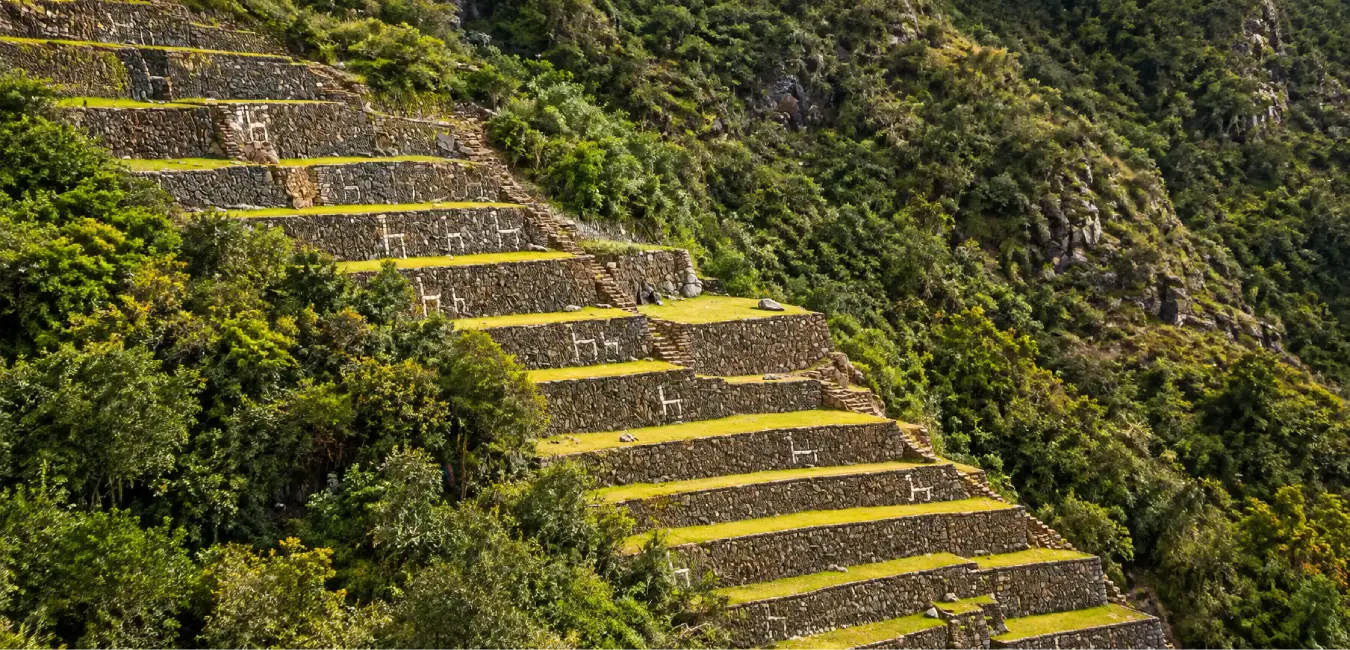
At Choquequirao, Inca builders decorated a section of terraces with more than twenty stone figures of llamas carved from white stone, known today as "Las Llamitas."
Llamas, Alpacas, Vicuñas, and Guanacos during the Colonial Period
With the arrival of the Spanish, European sheep and cattle occupied the best grazing lands, while uncontrolled hunting drastically reduced wildlife populations. Vicuña hunting continued for centuries, and by 1960, very few remained in Peru. Fortunately, in 1967, the government established the Pampa Galeras Reserve to protect them, and the species recovered.
Llamas, Alpacas, Vicuñas, and Guanacos today
Peru has one of the largest populations of South American camelids, especially Alpacas and Llamas. For thousands of high-Andean families, these animals remain an important source of income through their fiber, meat, and breeding. Vicuñas are also part of this heritage and are protected through conservation programs. Guanacos, meanwhile, are much less common in the country.
How to interact responsibly with camelids during your trip
Encountering a Llama, Alpaca, or Vicuña during your trip can always be a special experience. You simply need to approach them calmly, respect their space, and observe them without disturbing them. With these simple tips, you can enjoy the encounter, take great photos, and give the animals the peace and space they need.
Tips for interacting with Llamas, Alpacas, and Vicuñas during your trip
- Approach from the front and stay calm. Never approach from behind, because a frightened animal may kick.
- Feed them only if their handler allows it, and only give them grass or alfalfa. Bread and sweets can harm their digestion.
- Recognize signs of agitation. If the animal pins its ears back and raises its head, step away: it may be about to spit.
- Ask permission before photographing a shepherd's animals.
- Observe vicuñas and guanacos from a distance. Do not chase them or fly drones in protected reserves.
Tips for photographing camelids
- Take advantage of soft light. Between 7 and 9 in the morning and in the late afternoon, the sun highlights the texture of their wool.
- Get down to their level. At eye level, your portraits will have more expression, with the Andean landscape in the background.
- Bring a zoom lens for vicuñas. Since they run away when you get within 50 meters, a telephoto lens or your phone's optical zoom can make all the difference.
- Turn off your flash and avoid sudden movements so the animal stays calm.
How to recognize authentic Alpaca clothing
Many vendors sell acrylic garments as alpaca products. Therefore, before you pay, use these tests:
- Touch it. Real alpaca feels cool when you first touch it and then warms up; acrylic, on the other hand, feels warm and somewhat plastic from the start.
- Compare the price. If a "baby alpaca" sweater costs the same as an ordinary garment, it probably isn't genuine.
- Read the label. "Alpaca type" or "alpaca blend" indicates a mixture that sometimes contains very little alpaca.
- Buy from trustworthy places, such as cooperatives and community textile centers in Cusco or Chinchero.
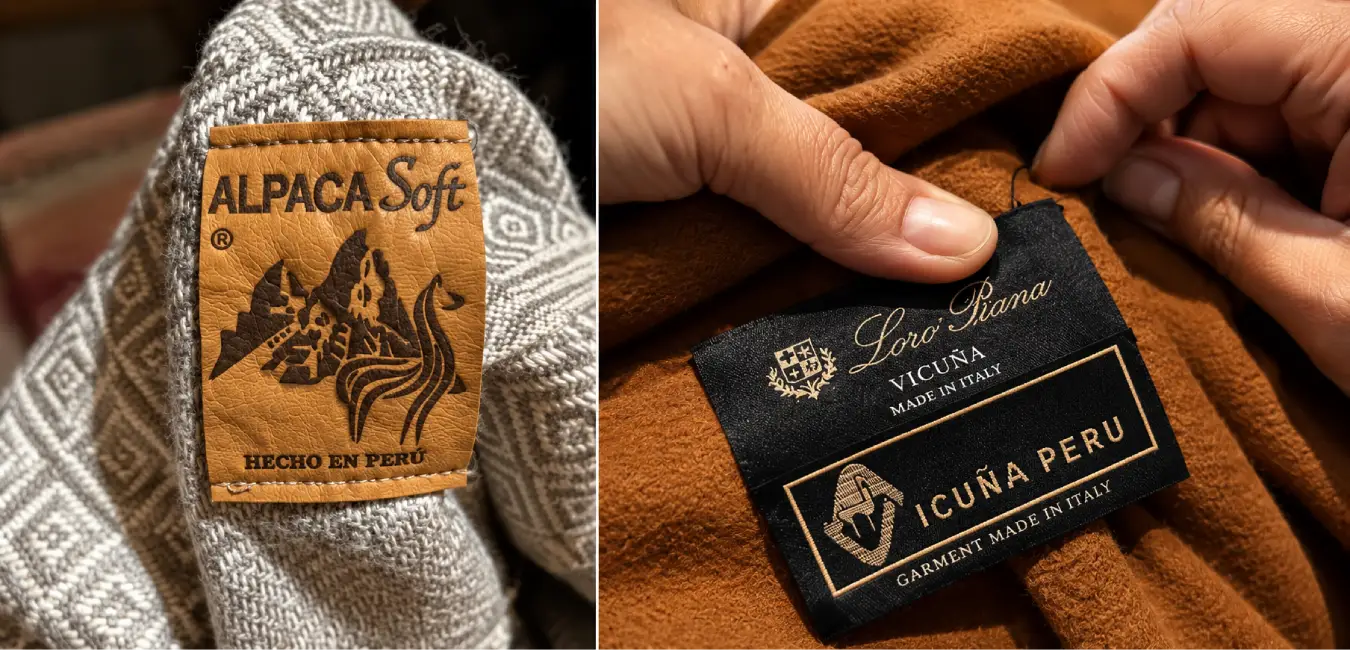
Certified garments made from authentic alpaca and vicuña fiber in Peru.
Baby Alpaca does not mean baby animal wool
"Baby alpaca" refers to a grade of fineness, around 22 microns, that usually comes from the first shearing. Above it is royal alpaca, which is even finer and rarer. If you are looking for vicuña, buy it only from authorized stores with proof of legal origin.
Fun facts about andean camelids
- They use communal bathrooms. They always deposit their droppings in the same place, which also helps mark their territory.
- They communicate with humming sounds. Alpacas make a soft humming sound to call their young or express curiosity.
- A bottle-raised llama can become aggressive. If it grows up only around people, as an adult it may treat humans as rivals.
- The guanaco spits with impressive accuracy. It can reach nearly two meters, and its young can run just a few minutes after birth.
“Would you like to see these animals during your trip to Peru? Write to us at Responsible Trekking and tell us which places you have in mind. We can help you combine trekking, nature, Andean culture, and responsible encounters with camelids in an itinerary made just for you.”
Frequently asked questions about Llamas, Alpacas, Vicuñas, and Guanacos
Can you ride a Llama?
No. Its back can only support a light load, far less than the weight of a person, even a child. Instead, you can walk alongside it and lead it by the rope with the help of a llama handler.
Do Llamas and Alpacas spit at people?
Rarely. They mainly spit at other animals to establish hierarchy; they only do it to a person if they feel threatened.
Can you eat Alpaca and Llama meat?
Yes. In Cusco, Arequipa, and Puno, you can try grilled alpaca, alpaca lomo saltado, or charqui. It is a lean, protein-rich meat. Vicuñas and guanacos, on the other hand, are protected.
Does shearing an Alpaca hurt it?
No. Breeders shear alpacas once a year, much like getting a haircut, and their fleece grows back.
What products are made from their fiber?
Chullos, scarves, sweaters, ponchos, blankets, and tapestries. Llama fiber, which is coarser, is also used to make ropes and rugs.
How much do people pay for a photo with an Alpaca in Cusco?
Families who walk around the historic center with alpacas usually ask for a voluntary tip of a few soles, which forms part of their livelihood. Ask before taking a photo.
Is it a good idea to visit them if i am traveling with children?
Yes. Alpacas are gentle, and Awanakancha is ideal for families. Even so, supervise young children and teach them to approach the animals slowly.
Where do their names come from?
Llama, wik'uña (vicuña), and wanaku (guanaco) come from Quechua; alpaca comes from the Aymara word allpaqa.