Llama Trail to Machu Picchu with Domes 6D/5N
- Duration
- 6 Days / 5 Nights
- Difficulty
- Moderate - Dificult
- Altitude
- 4 ,215 m / 13,828 ft
- Group Size
- 10 people
- Tour Language
- Espanish/English
Llama Trail with Domes + Classic Inca Trail 6D/5N is the complete version of our route: two days of mountain hiking between Cusco and the Sacred Valley, walking alongside llamas and their herders on the stretch that allows it and sleeping in a glass dome at 3,850 m (12,631 ft), followed by the four days of the classic Inca Trail from Km 82 to the Sun Gate.
Six days and around 70 km (43.5 mi) on foot. The first two days work as the best acclimatization you can get: by the time you reach Km 82 you will already have crossed a 4,200 m (13,779 ft) pass and your body will be ready for Dead Woman’s Pass. That is the difference between surviving the Inca Trail and enjoying it.
Highlights
- The classic Inca Trail, fully acclimatized, with two days of mountain hiking already in your legs
- A night at Andean Sky Dome before the three nights of camping
- The Sihua lagoons and the Pukamarca pass, at 4,200 m
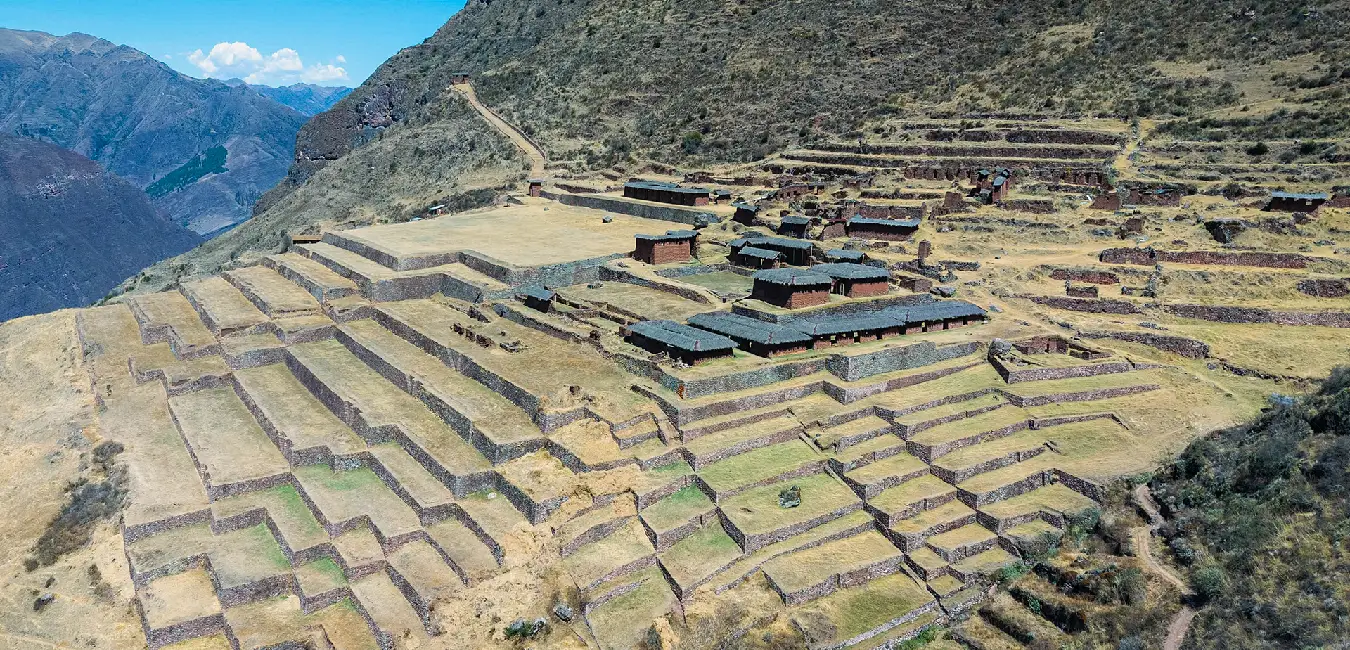
- Huchuy Qosqo, which you can reach on foot
- Dead Woman’s Pass, at 4,215 m
- Machu Picchu at sunrise through the Sun Gate
The Llama Trail with Domes at a glance
Day 1 :From the Qorikancha to the domes
Out of central Cusco on foot, Sacsayhuamán and the Piedra Escalada. Night in a mountain at Andean Sky Dome. (9 km / 5.6 mi · max. 3,850 m)
Day 2 :Sihua, Pukamarca and Huchuy Qosqo
The six lagoons, the Pukamarca pass and the descent to Huchuy Qosqo and Lamay. Night in Ollantaytambo. (15 km / 9.3 mi -max. 4,200m)
Day 3 :Km 82, Llactapata and Ayapata
The classic Inca Trail begins. A gentle first day up the valley to camp. (14 km / 8.7 mi · max. 3,300 m)
Day 4 :Dead Woman’s Pass
The big one: the highest pass on the Inca Trail, Runkurakay and Sayacmarca, down to Chaquicocha. (16 km / 9.9 mi · max. 4,215 m)
Day 5 :Phuyupatamarca and Wiñay Wayna
Original stone paving, Inca tunnels and the drop into cloud forest. Last night in camp. (10 km / 6.2 mi · max. 3,600 m)
Day 6 :Sun Gate and Machu Picchu
A pre-dawn start to reach the Sun Gate at sunrise and walk down into the citadel with your guide. Train to Ollantaytambo and back to Cusco. (6 km / 3.7 mi · max. 2,745 m)
What’s included
- Pickup from your hotel in Cusco.
- Tourist transport throughout the program.
- Professional guide for all six days.
- Official classic Inca Trail permit (Km 82), issued in your name.
- Full camping equipment: double tents, sleeping pads and a dining tent.
- Porters for the camping gear and the food.
- A cook and every meal on the trek: breakfasts, lunches and dinners.
- Lunch on the first day and dinner at the dome camp.
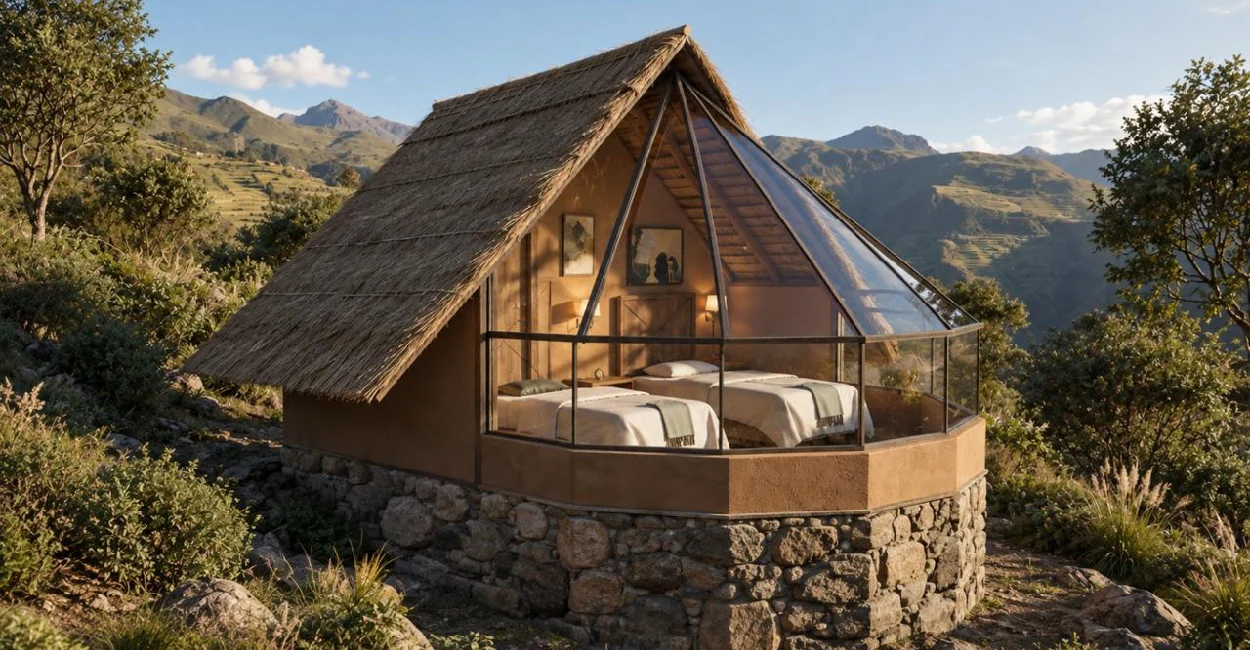
- One night in a mountain dome (glamping).
- One night in a hotel in Ollantaytambo.
- Three nights of camping on the Inca Trail.
- Transport from Lamay to Ollantaytambo.
- Aguas Calientes – Ollantaytambo train on the last day and transfer to Cusco.
- Bus from Machu Picchu down to Aguas Calientes.
- Machu Picchu entrance ticket, according to the confirmed circuit.
- Entrance to the sites listed in the itinerary.
- First-aid kit and emergency oxygen.
- Boiled and treated water during the camping days.
Not included
- Breakfast on the first day.
- Lunch on the last day in Aguas Calientes.
- Sleeping bag and trekking poles, which can be rented from us.
- Personal porter for your own belongings, available on request.
- Extra drinks and personal snacks.
- Huayna Picchu or Machu Picchu Mountain, which are separate tickets.
- Travel insurance.
- Personal expenses.
- Tips for the porter and kitchen team.
- Services not mentioned in the program.
Day 1: Cusco – Sacsayhuamán – Ñustapakana – Piedra Escalada – Mountain domes
At 6:30 a.m. we pick you up at your hotel and, instead of climbing into a van, you start walking. That’s what sets this route apart: it leaves the center of Cusco on foot. Your first stop is the Qorikancha, the Temple of the Sun, where your guide explains how the ceques radiated out from these walls, the lines that organized Inca territory, and why the path you’re about to follow exists at all.
The city falls away slowly: cobbled streets, the Twelve-Angled Stone, the Sapantiana aqueduct and, at the top of the climb, Sacsayhuamán. In ninety minutes you’ve gone from the historic center to the mountains without setting foot in a vehicle.
At the Balcón del Diablo, a rock ledge with the whole valley spread out below, we stop to refuel: snacks prepared by our team and served right there, with the best view you’ll have in a long time.
The trail continues along the northern slopes, through eucalyptus and old stone walls. Ñustapakana is an outcrop the Incas carved into steps, niches and seats. Farther on you come to the Piedra de Escalada, a rock face that Cusco’s climbers use today, in the same area where people run the river. Both are an hour from the Plaza de Armas, and almost nobody knows they’re there.
We walk slowly on purpose, because your body is still adjusting to the altitude. You reach the Andean Sky Dome with plenty of afternoon left: check in, sit down to a hot lunch cooked by our own chefs high in the mountains, and take an optional rock-climbing session if you still have the energy. Dinner comes later, at 12,631 feet. After dark, with not a single light anywhere around you, the dome’s clear roof does the rest.
Meals: snacks, lunch prepared by our chefs, and dinner.
Lodging: Andean Sky Dome, with a real bed, warm bedding and shared facilities.
Difficulty: moderate.
Distance: about 5.6 mi / 9 km.
Maximum altitude: 12,631 ft / 3,850 m.
Sites visited: Qorikancha, Sacsayhuamán, Ñustapakana and the Piedra de Escalada.
Weather: mild during the day, cold at night.
Day 2: Domes – Ruyaq Corralniyoc – Sihua Lagoons – Pukamarca Pass – Huchuy Qosqo – Lamay – Ollantaytambo
After breakfast you leave the dome and the trail climbs without a break for about two hours to Ruyaq Corralniyoc, at 13,451 ft (4,100 m). The trees give out, bunchgrass covers everything, and raptors start to appear over the ravines.
This is a climb for short steps and steady breathing. If you need to stop, a few seconds on your feet beats sitting down every little while. Your guide sets the pace, and nobody is in a hurry.
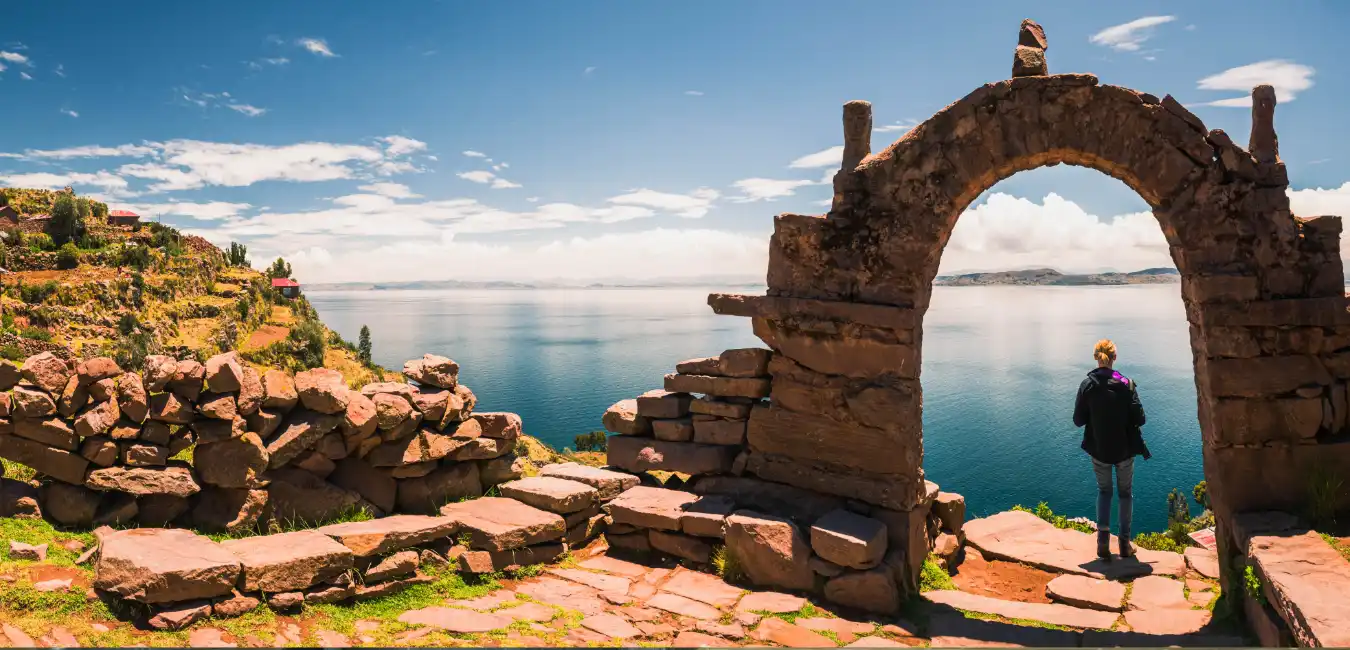
Then come the Sihua lagoons, six of them, one after another. Huallatas and wild ducks nest at the first, llamas are usually grazing at the second, and the third is the largest. You watch them from the trail and at a distance: puna vegetation takes years to recover from a single step off the path.
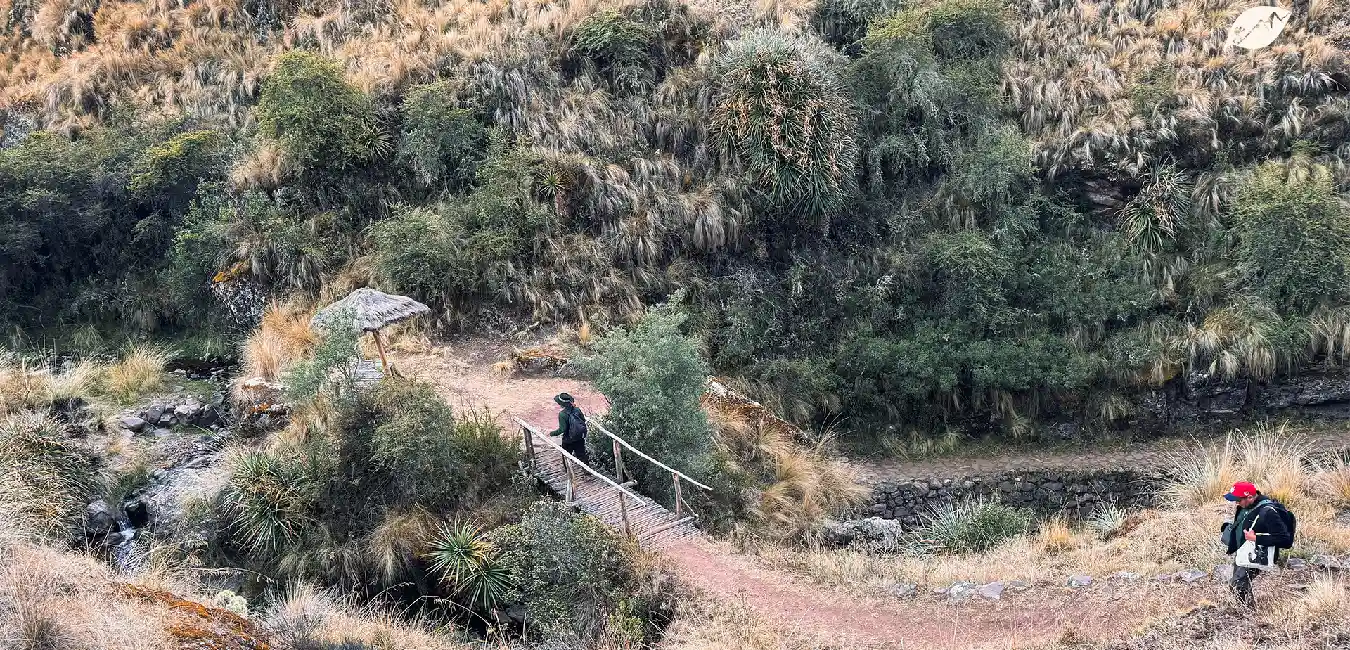
Before moving on, you take your time over a boxed snack out on the open puna, with the lagoons right beside you. After that, the Pukamarca pass, at 13,779 ft (4,200 m), marks the high point and the end of the climbing. From there it’s all downhill through a canyon on an easier grade, until the bunchgrass turns to scrub and cactus and the Sacred Valley opens up below. At the bottom is Huchuy Qosqo, with its double-jamb doorway, the kallanka, the terraces, the water channel and the storehouses of the administrative center attributed to the Inca Wiracocha. Once you arrive, our chefs serve the lunch they’ve prepared fresh on the spot.
From there you descend to Lamay, where our transport takes you to Ollantaytambo Tomorrow at 6:00 a.m. the classic Inca Trail begins, and you reach it with two days of mountain hiking in your legs and the altitude already behind you.
Meals: Breakfast and lunch prepared by our chefs.
Accommodation: Hotel in Ollantaytambo.
Difficulty: Moderate to challenging.
Distance: Approximately 15 km / 9.3 mi.
Maximum altitude: Pukamarca pass, 4,200 m / 13,779 ft.
Sites visited: Ruyaq Corralniyoc, the Sihua lagoons, the Pukamarca pass and Huchuy Qosqo.
Weather: Cold up on the puna and mild on the way down to the valley.
Day 3: Ollantaytambo – Km 82 – Llactapata – Ayapata
The classic Inca Trail starts at 6:00 a.m. with pickup at your hotel in Ollantaytambo. From there it is a short drive to Km 82, following the Urubamba River past farmland and villages that still live off the land. At the official checkpoint they register your passport and your permit, you cross the bridge, and the trail begins.
This first day on the trail is deliberately gentle: about 14 km (8.7 mi) with almost no elevation gain, designed to get you into a rhythm and to meet the team. Because from today on you are not hiking alone. Along with your guide come the porters and the cooks, who move ahead, pitch camp before you arrive and cook every meal out in the mountains. Mid-morning Llactapata appears, a set of agricultural terraces above the river that fed the people who traveled this same road.
You reach Ayapata, the first campsite, at around 3,300 m (10,827 ft), with the tents already pitched. Dinner is served hot in the dining tent and, without a single light anywhere around, the night sky on that first night in camp is one you remember.
Meals: Breakfast, lunch and dinner.
Accommodation: Camp at Ayapata, approximately 3,300 m / 10,827 ft.
Difficulty: Moderate.
Distance: Approximately 14 km / 8.7 mi.
Maximum altitude: Approximately 3,300 m / 10,827 ft.
Sites visited: Llactapata.
Weather: Mild during the day and cold at night.
Day 4: Ayapata – Dead Woman’s Pass – Pacaymayo – Runkurakay – Sayacmarca – Chaquicocha
Today is the hard day, and it helps to know that over breakfast. It opens with a continuous four-hour climb to Dead Woman’s Pass, at 4,215 m (13,828 ft), the highest point on the entire Inca Trail. There is no trick and no shortcut: you go up slowly, breathing evenly, stopping when your body asks for it. The advantage is that you arrive with two days of mountain hiking behind you and the Pukamarca pass already crossed.
At the top, the pass is a ridge between two peaks and there is almost always wind. It is the photo moment, and also the moment you realize the hardest part of the trip is behind you. From there you drop into the Pacaymayo valley down a long Inca staircase, where your knees work harder than your lungs.The afternoon delivers three sites in a row. Runkurakay, a circular structure that served as a lookout over the trail. Sayacmarca, perched on a rocky spur reached by a narrow stone staircase. And then a landscape that turns greener and greener all the way to Chaquicocha, the second night’s camp. It is the longest day and also the most complete of the whole route.
Meals: Breakfast, lunch and dinner.
Accommodation: Camp at Chaquicocha, approximately 3,600 m / 11,811 ft.
Difficulty: Challenging.
Distance: Approximately 16 km / 9.9 mi.
Maximum altitude: Dead Woman’s Pass, 4,215 m / 13,828 ft.
Sites visited: Runkurakay and Sayacmarca.
Weather: Cold, above all in the morning and at the mountain passes.
Day 5: Chaquicocha – Phuyupatamarca – Wiñay Wayna
Ask any guide which is their favorite day on the Inca Trail and almost all of them say this one. The trail enters cloud forest and for hours you walk on original stone slabs, laid more than five hundred years ago, among ferns, moss and orchids hanging from the trees.
The first stop is Phuyupatamarca, the place above the clouds: terraces and ritual fountains set into the hillside. On a clear day you can see half the valley; in fog, the site appears and disappears among the clouds, which many people like even better. After that come almost two thousand steps down.
At the bottom of that staircase is Wiñay Wayna, which means Forever Young: a fan of terraces suspended above the canyon beside a waterfall, and the most beautiful site on the whole trail. The last campsite is very close by. That night your guide gives the final briefing, because tomorrow starts before dawn.
Meals: Breakfast, lunch and dinner.
Accommodation: Camp at Wiñay Wayna, approximately 2,650 m / 8,694 ft.
Difficulty: Moderate.
Distance: Approximately 10 km / 6.2 mi.
Maximum altitude: Phuyupatamarca, approximately 3,600 m / 11,811 ft.
Sites visited: Phuyupatamarca and Wiñay Wayna.
Weather: Milder and more humid, in cloud forest.
Day 6: Wiñay Wayna – Sun Gate – Machu Picchu – Ollantaytambo – Cusco
The last day begins in the dark. After breakfast you walk a little over an hour along the mountainside to Inti Punku, the Sun Gate, the entrance used by everyone who traveled this road. As you step through it, Machu Picchu appears below you, whole. After five days of hiking, that minute is the one people remember for the rest of their lives.
From the Sun Gate it is about forty minutes down to the citadel. With your guide you visit the sectors your ticket allows according to the assigned circuit, and everything you have walked over these days changes the visit completely: you are no longer looking at an isolated ruin, but at the end of a network of roads you started walking at the Qorikancha.
Afterward you take the bus down to Aguas Calientes, with time for lunch on your own, a shower or a stop at the hot springs before boarding the train to Ollantaytambo. Our transport meets you at the station for the drive back to Cusco, arriving at around 7:30 p.m. depending on the confirmed train schedule.
Meals: Breakfast. Lunch in Aguas Calientes is on your own.
Accommodation: Not applicable; the program ends in Cusco.
Difficulty: Easy to moderate.
Distance: Approximately 6 km / 3.7 mi.
Maximum altitude: Sun Gate, approximately 2,745 m / 9,006 ft.
Sites visited: The Sun Gate (Inti Punku) and Machu Picchu.
Weather: Cool in the morning and warmer during the day
What to bring
- Original passport: it is required, and it must be the same one your Inca Trail permit was issued with.
- Small day pack.
- Comfortable hiking boots or shoes.
- Hiking clothes.
- Waterproof jacket or rain poncho.
- Warm clothing for the evenings.
- Hat or cap.
- Sunglasses.
- Sunscreen.
- Reusable water bottle.
- Personal snacks.
- Personal medication.
- Portable charger.
- Camera or phone.
- Cash in soles.
- Trekking poles, if you use them.
Price
Price from: USD 1,260 per person.
The price may vary depending on the date, Inca Trail permit availability, number of travelers, type of service, train category, and additional services included.
Private service: Available upon request. The price will depend on the group size and the level of customization required.
Important note: this route uses the classic Inca Trail from Km 82, and permits are limited, nominal and non-transferable. They usually sell out several months in advance, especially between April and October, and the trail is closed every February for maintenance. We recommend booking as early as possible, with your passport details exactly as you will travel.
Additional Services Available
Equipment Rental
The first night is in a mountain dome, with a real bed and warm bedding, and the second is in a hotel in Ollantaytambo. You only need camping gear for the three nights on the Inca Trail. If you do not want to bring all your gear from home, you can check availability for renting some items, such as:
Sleeping bag.
Inflatable sleeping mat.
Trekking poles.
Single tent.
Prices may vary depending on availability and must be confirmed before the trek begins.
Additional Porter
If you would like to carry more than the allowed weight in the included duffel bag, you can request an additional porter, subject to availability and Inca Trail regulations.
This service must be booked in advance, as porters must also be registered within the official Inca Trail permit and logistics.
Huayna Picchu or Machu Picchu Mountain
Depending on availability, it may be possible to add Huayna Picchu or Machu Picchu Mountain on the last day, after you arrive through the Sun Gate. These tickets are limited and must be booked in advance. They have an additional cost and are subject to availability from the Ministry of Culture.
Please note that both climbs come after six days and around 70 km on foot, so we will be honest with you about whether it is a good idea for your group.
Train Upgrade
The tour includes the return train from Aguas Calientes to Ollantaytambo according to the confirmed service. If you would like a more panoramic or higher-category train, such as Vistadome or Hiram Bingham, an upgrade can be quoted, subject to availability and schedule.
Frequently asked questions
How long is the program?
The route runs 6 days and 5 nights: two days in the mountains with a dome and a hotel, and four days on the classic Inca Trail with three nights of camping
How many miles do you hike?
Around 70 km (43.5 mi) in total: 9 km on day one, 15 on day two, 14 on day three, 16 on day four, 10 on day five and 6 on the last day.
What is the maximum altitude?
Dead Woman’s Pass, at 4,215 m (13,828 ft), on day four. On day two you already cross the Pukamarca pass at 4,200 m, which is exactly the best preparation you can get.
Where will I sleep?
The first night in a mountain dome, the second in a hotel in Ollantaytambo and the next three in camp, in double tents pitched by our team.
Does the route include llamas?
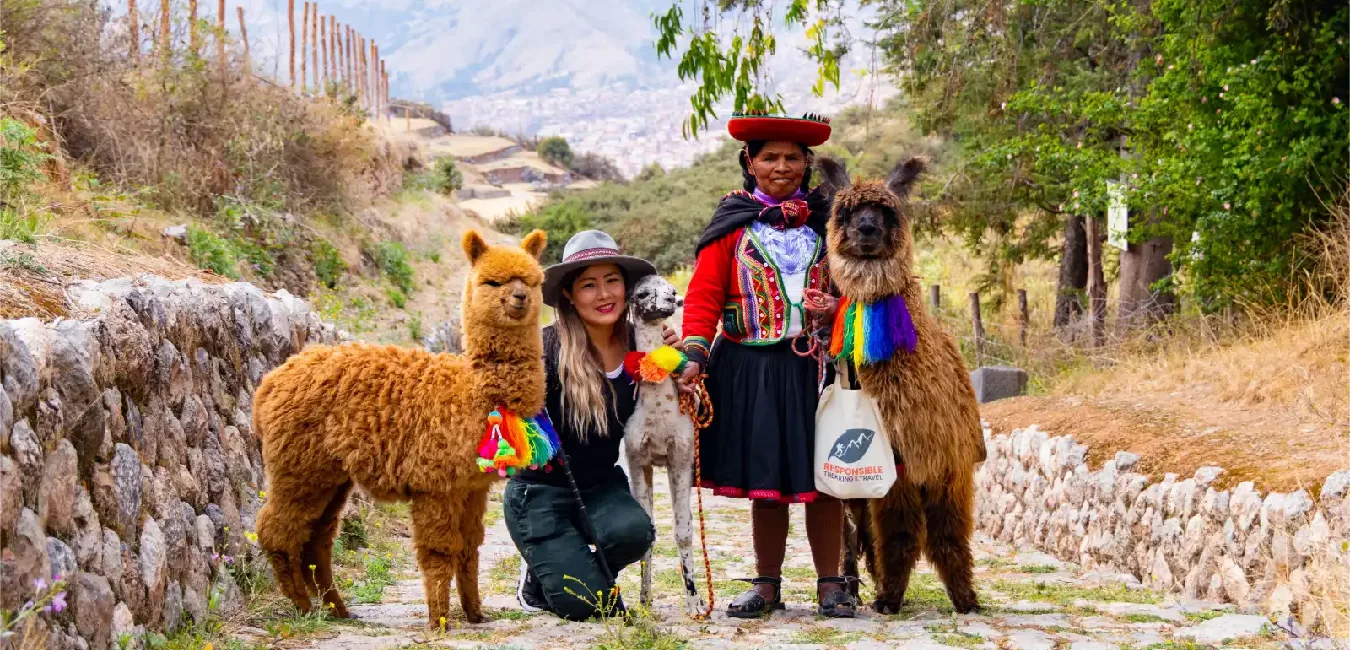
The idea behind the Llama Trail is hiking alongside llamas and herders from the local communities on the mountain section, between the domes and Huchuy Qosqo. Their participation depends on the families’ availability on each date and is confirmed according to that day’s operation.
Do I need a permit for the Inca Trail?
Yes, and this is the single most important point. The classic Inca Trail has a limited daily quota, the permit is issued in your name with your passport number, and it cannot be transferred to another person or another date. Between May and September permits sell out five to six months in advance. On top of that, the entire Inca Trail closes every February for maintenance.
Do I need trekking experience?
You do not need technical experience, but you do need to be in good shape: six consecutive days of hiking, three nights in a tent and a 4,215 m mountain pass. If you train by walking with a pack in the weeks beforehand, you will enjoy it far more.
What happens to my large luggage?
You can leave it at your hotel in Cusco or at our office at no cost. On the trek you carry only a day pack; the porters move everything else.