
When you ask people who have trekked through the mountains of Machu Picchu, they’ll tell you it’s not the ruins that surprised them; it’s the porters. You’re hiking up a mountain at 12,000 feet when you realize a porter carrying a stove, a propane cylinder, and three tents, all on his back, passes you by and greets you in Quechua.
But for years, there was one part about this that wasn’t so great; the men were transporting cargo no one else would dare move, in exchange for a meager pay, with no compensation in case something went wrong. In 2022, however, things started to change when Peru enacted Ley 31614 and revised them again in 2024 with Ley 32137.
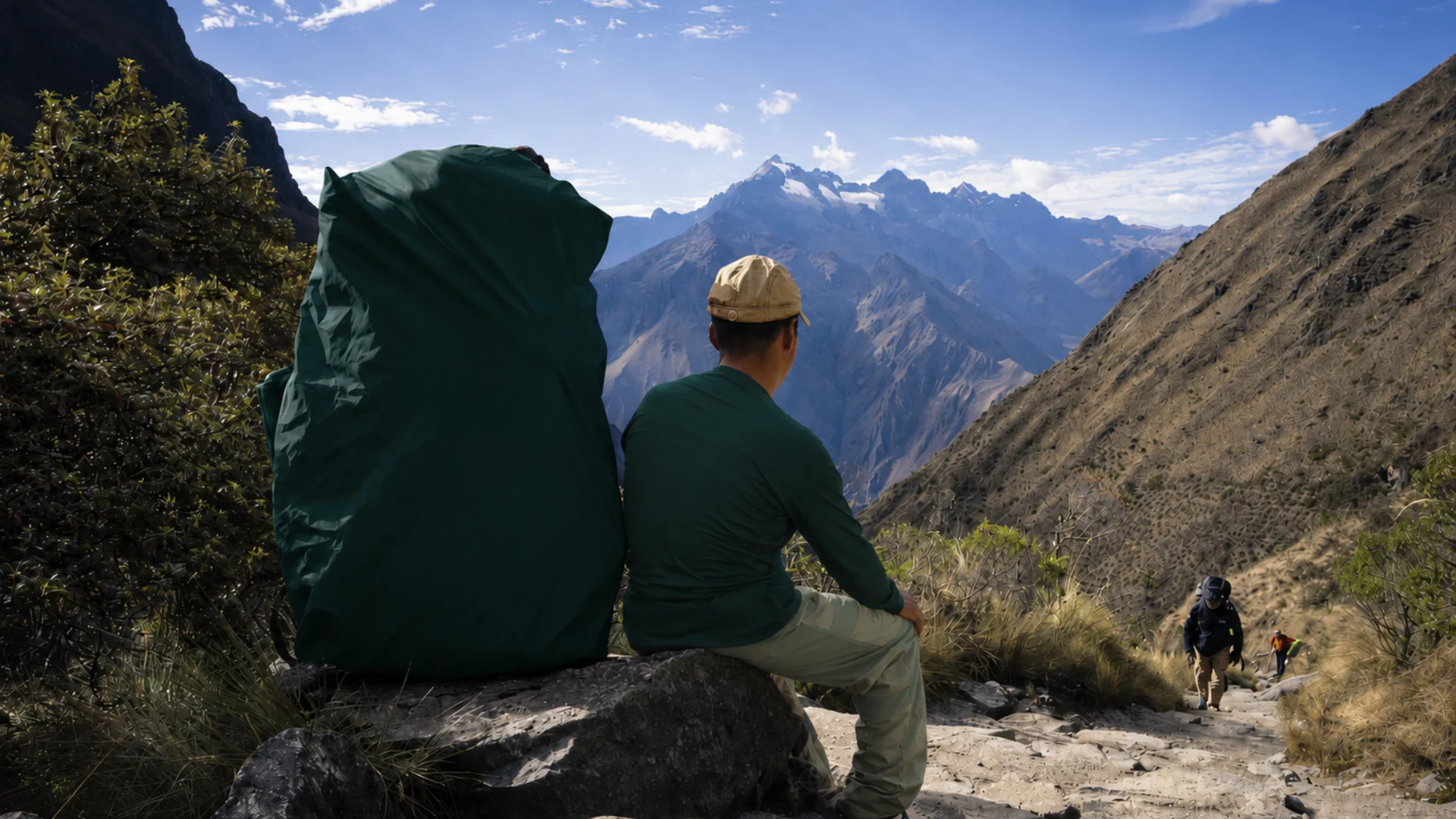
Who are the porters, and what does their work involve?
Article 3 of Ley 31614 describes a porteador as a laborer who utilizes his own body and manual work to transport supplies, gear and personal luggage for treks, across areas inaccessible by motorized vehicles.
They are Quechua speaking peasants mostly from high altitude villages surrounding Cusco – Mollepata, Lares, Ollantaytambo, Wayllabamba and others in the Sacred Valley area.
It is not allowed to use pack animals on the Inca Classic trail as the mules would cause damage to the original stone structures and that is exactly why the trek requires human workers.
Porter services on a four-day hike
- Provisioning help: They carry all cooking equipment, gas, dining and sleeping tents, and enough food supplies to last four days.
- Trekking gear: They transport hiker duffels, which have a weight restriction of about 5-7 kg (11-15 lbs).
- Lodging services: They dismantle the camp once the group moves on, catch up with the group, and set up camp, cook, and wait for the arrival of the trekkers.
- Preservation help: They clean all the garbage from the campsite, since nothing is supposed to remain inside the protected site.
What does the porter law require?
Minimum age
Eighteen years old, with no exceptions. In addition, the law requires equal opportunity and non-discrimination, which explains why there are now mixed and female crews for the trails that until then had been only for men.
Hours of work and resting
A workday equals an expedition, from starting point to final point, up to a maximum of 48 hours per week. Any additional time constitutes overtime, which should be guaranteed along with a weekly rest by the employer.
It is precisely this clause that has been misinterpreted in almost all the guides currently available. The initial version of the 2022 law stated that the porter could enjoy five consecutive days of rest between expeditions. Ley 32137 changed that provision in October 2024, leaving the mandatory weekly rest without any fixed term of days between treks.
Maximum load
Twenty kilograms (44 lb) for males, fifteen (33 lb) for females, verifiable by the labor inspection agency and verified with a scale at the control post Km 82 in Piscacucho before anyone is allowed to access the trail. That limit is the reason why your personal duffel must have a maximum weight of approximately 5–7 kg because the porter’s personal clothing, blankets and provisions are added to the company load.
Food, clothing and equipment
Everything at no cost to the worker: nutritious food, high altitude clothing, protective equipment, back brace, sunscreen, sleeping equipment, and proper overnight accommodation, as well as SCTR insurance for risky activities and life insurance.
Pay
The minimum is 3% of one UIT per working day. One UIT is the reference unit of Peru, and its value increases each January, so the porter’s minimum wage is automatically updated without the need for any amendments to the law by Congress.
| Item | What the law establishes |
|---|---|
| Governing laws | Ley 31614 (2022), amended by Ley 32137 (2024) |
| Minimum age | 18 years, no exceptions |
| Maximum load | 20 kg men / 15 kg women |
| Working hours | Max 48 hours per week; overtime beyond that |
| Rest | Mandatory weekly rest guaranteed by the employer |
| Minimum daily pay (2026) | S/165 (3% of one UIT of S/5,500) |
| Insurance | SCTR plus life insurance, employer-paid |
| Equipment | Clothing, PPE, lumbar belt, sun protection, sleeping gear |
| Employment status | Independent worker, fourth-category tax regime (since 2024) |
Companies that comply with the law governing porters on the Inca Trail
As reported in a comment by Reddit user HeatherJasperTravels, who claimed that she had just interviewed Juan Ccama Arias, who is the Vice President of the Association of Porters, the following companies were found to be adhering to the regulations regarding weight capacity and pay for porters on the Inca Trail.
Company | Evidence of responsible porter practices | Website |
|---|---|---|
Evolution Treks | Identified as complying with legal weight limits and porter wage requirements. | evolutiontreks.co |
Intrepid Travel | Identified as following regulations concerning porter weight limits and wages on the Inca Trail. | intrepidtravel.com |
Responsible Trekking | Identified as complying with legal weight limits and wage requirements for porters. | responsibletrekking.com |
EcoInca | Identified as complying with legal requirements concerning porter weights and wages. | EcoInca |
Apus Peru | Identified as following legal requirements concerning porter weight limits and wages. | Apus Peru |
How much should you tip Inca Trail porters?
Tips are customary and not mandatory; they are placed over and above the wages paid. Companies that say that tips are "part of what porters earn" are confessing to being guilty of such actions.
| Crew member | Common reference | How it works |
|---|---|---|
| Porters | S/45 - S/100 per traveler in the group | Pooled by the group and distributed at the end of the trek |
| Cook | S/80–S/150 per group | Usually receives a separate envelope |
| Guide | US$15–US$20 per traveler | Depends on group size and service |
Tipping etiquette on the trail
- Tips are handed over on the final night, after dinner, before the Machu Picchu morning.
- Bring soles in small bills from Cusco. There are no ATMs and no card payments on the trail.
- Someone in the group usually says a few words of thanks before the envelopes go out.
- A respectful "buenos días" when a porter passes you costs nothing and lands well.
Questions to ask an agency before you book
What exactly do you pay your porters per day, and how does that compare to the legal minimum?
Are they covered by SCTR and life insurance, and who pays for it?
What do the porters eat, and where do they sleep on the trek?
How many porters travel with a group of our size, and what load does each carry?
Do you provide boots, jackets and lumbar belts, or are porters expected to bring their own?
What is your emergency and evacuation plan for a crew member, not just for clients?
The industry problem behind the law
A Reddit user, stating that she had interviewed Juan Ccama Arias, Vice President of the Association of Porters, pointed out an industry-wide issue related to the problem of porters' wellbeing being neglected, even though the companies promise sustainability in their operations.
As she explained, the issues of porter weights and wages have always been a major problem, with some companies reportedly not complying with the laws. She also stressed that the same problems are found among tour companies working in trekking destinations all over the world.
For customers, the lesson is clear: make sure you know how the company deals with its porters before choosing it for your adventure.
Frequently asked questions about the Peru porter law
How much does an Inca Trail porter have to carry?
The maximum weight limit allowed is 20 kilograms for men and 15 kilograms for women, measured on a scale before entering. The company that takes you on your tour makes sure that your belongings do not take up your weight allowance.
Is the porters' act on the Inca Trail actually implemented?
In the case of Inca Trail, implementation is significant the control of weights in Km 82 is indeed done, and the power to control load limitations is included in the law. The enforcement of salaries, insurance, and resting conditions is much harder to implement, and the associations of porters still claim some problems with that.