
Deep in the cloud forest of Vilcabamba, a few hard hours past Cusco, Perú, there's a rumi rock the Incas believed could talk to the mountains. It's not on any postcard. Most tour buses have never heard of it. And yet in its day, this single carved white rock may have been one of the most sacred objects in the entire empire — sacred enough that Spanish priests once tried to burn its power away. Here's the full story of Yurac Rumi, what it actually looks like up close, and how you can go see it for yourself.
What Is Yurac Rumi, and What Does the Name Mean?
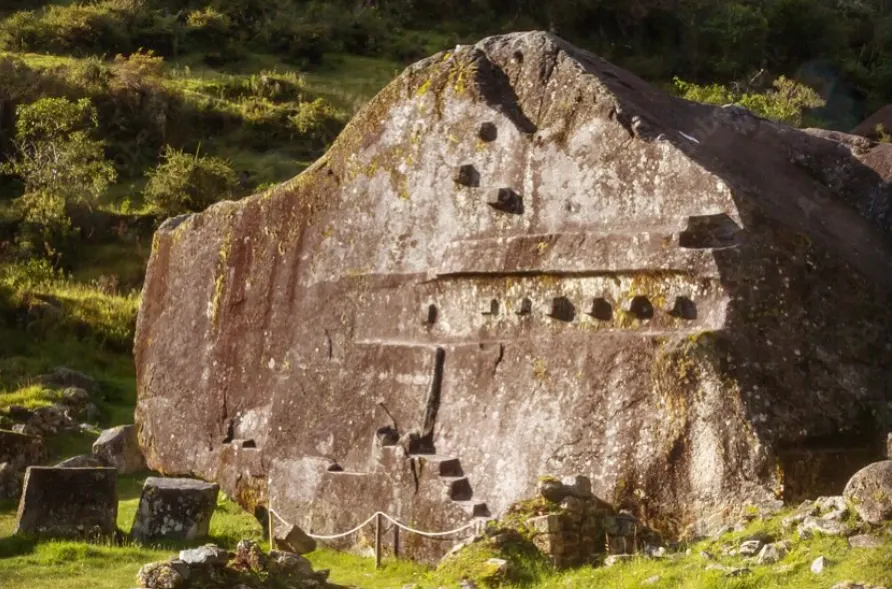
Yurac Rumi, the rumi rock peru site, means exactly what it sounds like in Quechua: "white rock." As a rumi rock in Peru, it refers to a massive carved granite outcrop that once served as a ceremonial altar — what the Incas called a huaca — for the empire's ruling elite.
Peru's Ministry of Culture doesn't treat it as a minor curiosity, either. Officially, this rumi rock site is classified as a temple, one of the highest designations a cultural monument in Peru can carry.
Chuquipalta, the "Flat Golden Stone" — Where the Other Name Comes From
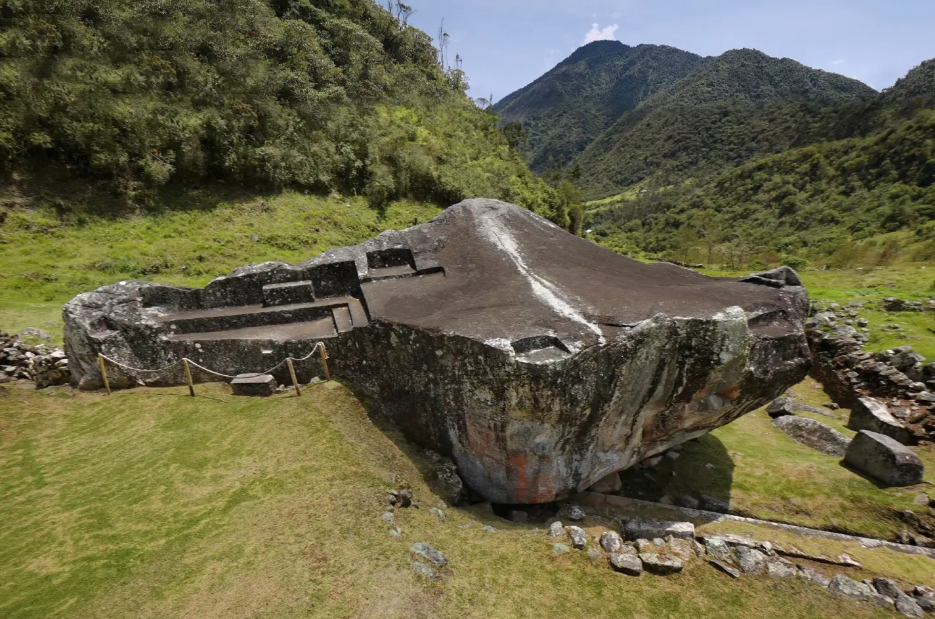
Before "Yurac Rumi" became the name everyone uses, Spanish chronicler Father Bernabé Cobo wrote about this same rock under a different name: Chuquipalta, which he translated as "flat golden stone."
Cobo grouped it alongside other huacas he documented near water sources — Saqsaywaman, Chincheros — a pattern that shows up again and again in Inca religion. Wherever water surfaced from solid rock, the Incas built something sacred around it.
Yurac Rumi, Ñusta Hispana, Vitcos: Sorting Out the Names
If you start researching this place, the overlapping names get confusing fast. Ñusta Hispana is the name for the whole archaeological site. Yurac Rumi is the carved rock at its center — the main event.
Vitcos, sometimes called Rosaspata, is a separate but neighboring complex that functioned as the administrative and residential core of the same settlement. In practice, people use these names almost interchangeably, but technically Yurac Rumi is just one (extraordinary) feature within the larger Ñusta Hispana grounds.
Where to Find the White Rock in Vilcabamba
Yurac Rumi, the rumi rock peru site, sits at 3,150 meters above sea level in the Vilcabamba district, La Convención province, Cusco region — inside land still governed by the Comunidad Campesina de Lucma.
This isn't the Sacred Valley most travelers picture when they think of Peru. It's wetter, steeper, and far less developed: the edge of the Andes where the mountains start dropping straight into the Amazon.
Its Relationship to the Vitcos Ruins Nearby
You'll almost never see Yurac Rumi mentioned without Vitcos right beside it, and that's because the two were part of the same living settlement. Vitcos is where Manco Inca II — the Inca resistance leader — was assassinated. If Vitcos was where the empire's last rulers governed, Yurac Rumi was where they went to worship.
An 8-Meter Granite Rock Carved by Hand
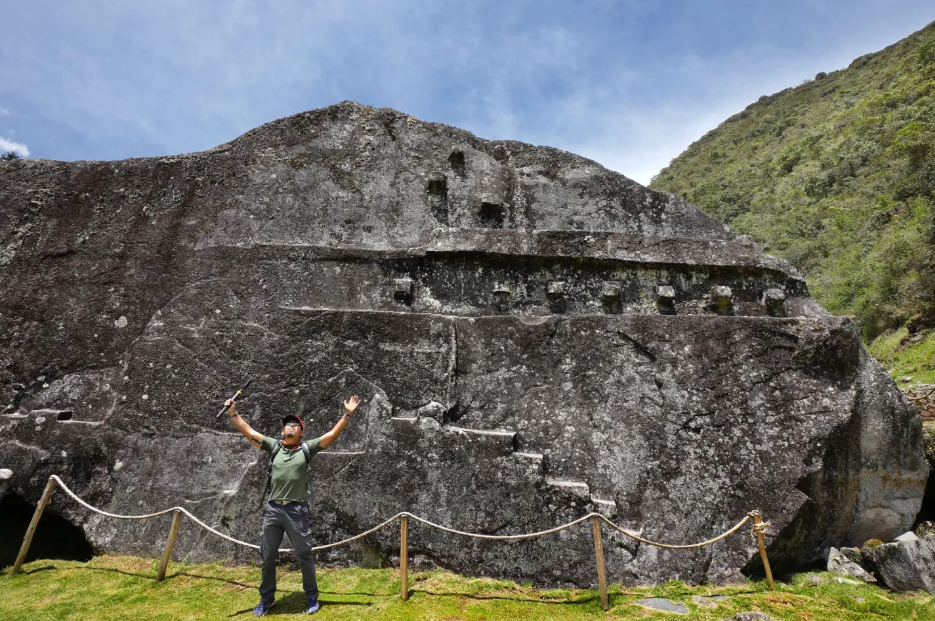
According to Peru's official tourism inventory, the rock itself measures 8.3 meters long, 6.6 meters wide, and 7 meters tall. This isn't a boulder you'd walk past without noticing — it's a genuine monument, covered in fine reliefs and carved symbols, surrounded by a scatter of smaller worked stones that make it clear this whole area was built up deliberately over time, not just used once and abandoned.
Steps, Terraces, and Cuts Aligned to the Cardinal Points
The top of the rock has been carved into small flat platforms, shaped almost like steps — and they're oriented toward the cardinal directions. That's not decoration. Directional alignment shows up at ceremonial site after ceremonial site across the Inca world, and it's one of the clearest signs that Yurac Rumi wasn't just admired, it was actively used as a ritual tool.
The Spring That Still Flows Beneath the Stone
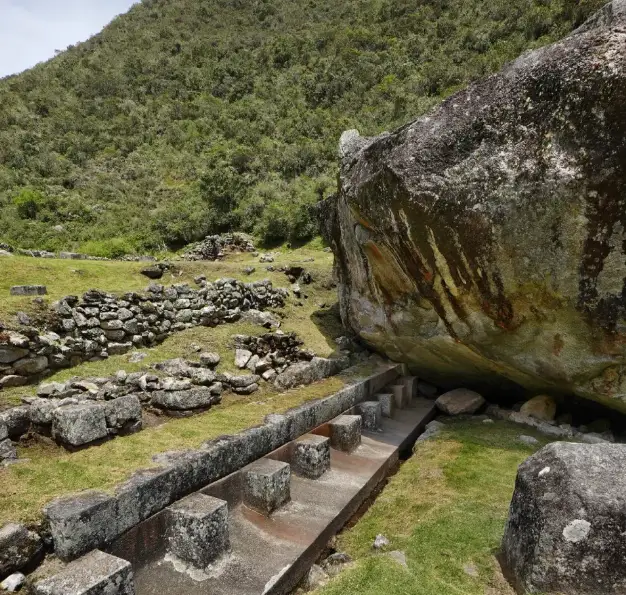
Underneath the rock, a natural spring still emerges straight from the mountain, and the Incas didn't just leave it running wild — they channeled it into a built stone fountain. In Andean belief, water bursting out of solid rock wasn't a geological quirk. It was the mountain speaking. That's very likely why this exact boulder, out of every rock in the valley, became sacred in the first place.
A Solar Calendar in Stone? What the Astronomical Theory Says
Researchers Von Kaupp and Fernández have argued that the smaller structures around the main rock — including doorways with double jambs — served an astronomical purpose tied to sun worship. The idea isn't that the Incas simply admired the sun symbolically here. It's that they may have used this site to actually track it, likely to pinpoint solstices or key moments in the farming calendar.
The Story Behind Yurac Rumi
The Last Sanctuary Worshipped by Inca Royalty
Some historians go as far as calling Yurac Rumi the last sacred site actively worshipped by Inca royalty before the empire finally collapsed. That's a meaningful distinction — plenty of Inca ruins had already fallen quiet by the time the Spanish showed up. This one hadn't.
How Two Spanish Friars Tried to Burn the Rock's Power Away
The most dramatic chapter of this rock's history plays out during the reign of Titu Cusi Yupanqui, the neo-Inca ruler based nearby in Vilcabamba. While Titu Cusi was away, two Augustinian friars named Marcos and Diego led recently converted natives to the site, burned down the Temple of the Sun, and scorched Yurac Rumi itself. This wasn't random vandalism. It was a deliberate exorcism — an attempt to burn out what the friars saw as a genuine rival to their god.
Hiram Bingham Finds the Site in 1911
Hiram Bingham III — the American explorer who later made Machu Picchu world-famous — documented Yurac Rumi on August 9, 1911. His account of the friars' attack on the rock remains one of the main historical sources for what actually happened here during the colonial period.
From Ruins to Restoration: The Digs of 1979, 1999, and 2007
Compared to most Inca sites this remote, Yurac Rumi's modern history is unusually well documented. Anthropologist Wilfredo Yépez carried out detailed surveys, photographic recording, and cleaning of Ñusta Hispana between 1979 and 1980.
In 1999, anthropologist Pedro Taca cleaned Vitcos, Rosaspata, Ñusta Hispana, and the surrounding river area — and tourism to the region picked up not long after. By 2007, the site had gone through formal restoration, including repairs to the surrounding walls and structures.
Why the Incas Worshipped a Rock
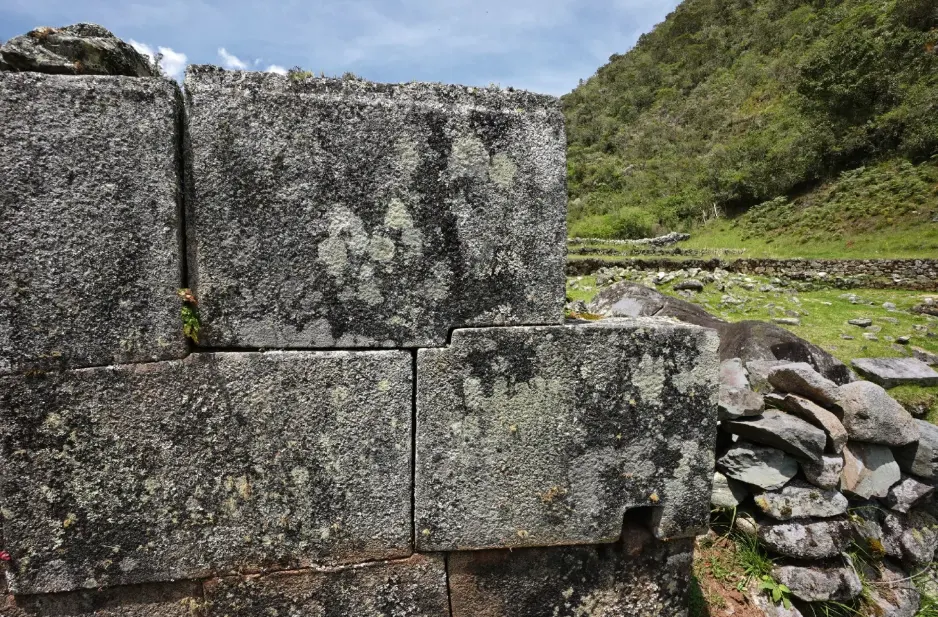
To understand Yurac Rumi, you have to understand what a huaca actually is. In Andean religion, a huaca is any object, place, or natural feature considered sacred — a mountain peak, a spring, an oddly shaped rock, even a mummified ancestor. These weren't symbolic the way a statue in a church is symbolic. Huacas were believed to genuinely hold spiritual power. Yurac Rumi checks every box: an unusual natural formation, a spring running beneath it, and a commanding presence over the whole valley.
And this isn't purely a history lesson. Peru's own tourism records list "mystic or traditional rituals" as an activity that still happens at the site today, right alongside photography and trekking. For some visitors and local guides, Yurac Rumi isn't a relic — it's still a living sacred place.
Yurac Rumi and the Last Days of the Inca Resistance
After the Spanish conquest, Manco Inca II retreated from Ollantaytambo deeper and deeper into the Andes, eventually founding the neo-Inca state centered on Vilcabamba. Right next to Yurac Rumi, at Vitcos, Manco Inca II was killed by Spaniards he had personally sheltered — a betrayal that marked a real turning point in the resistance.
His son, Titu Cusi Yupanqui, kept ruling from the same region, during the very period when the friars attacked the rock. In other words, Yurac Rumi sits right at the geographic and emotional center of the empire's final years.
Could Yurac Rumi Predate the Incas? The Lost-Civilization Theory
Search around online and you'll run into a persistent claim: that the precision of Yurac Rumi's cuts is simply too advanced for the bronze and stone tools the Incas are known to have used, suggesting the site was originally built — and later reworked — by some older, unidentified civilization. It's the same argument you'll see applied to Sacsayhuamán, Ollantaytambo, and Q'enqo.
What Archaeologists Like Bauer and Vincent Lee Actually Found
The academic record tells a much less dramatic story. Researcher Brian Bauer published a detailed study specifically on the destruction of the Yurac Rumi shrine, and Vincent Lee, author of Forgotten Vilcabamba, both attribute the carving directly to Inca craftsmanship — consistent with stonework documented at other confirmed Inca sites of the same period.
Peru's own heritage records back this up without hesitation, describing the site as unmistakably Inca in origin. The lost-civilization theory makes for great internet content. It just isn't supported by the evidence.
Planning a Visit to Yurac Rumi
The Route: Quillabamba, Chaullay, Huancacalle, and a 35-Minute Walk
Getting here takes some real effort, but the route itself is well documented. From Quillabamba, a paved-road bus covers 22.5 kilometers to Chaullay in about 30 minutes. From Chaullay, a combi handles the rougher 50.2-kilometer stretch to Huancacalle, taking roughly an hour and twenty minutes over unpaved road.
The last leg — Huancacalle to Yurac Rumi — is a 2-kilometer walk along a traditional footpath, about 35 minutes on foot. Most travelers reach Quillabamba from Cusco first, either directly or via Santa María.
It's Free — Here's the Registration and Hours
Entrance is free. You simply register when you arrive. The site is open every day of the year, from 8:00 a.m. to 5:00 p.m.
Best Time to Go
Officially, there's no restricted season — Yurac Rumi is open year-round. That said, this is high-jungle terrain, so drier months tend to make the footpath easier and the views clearer.
Where to Sleep and Eat Along the Way
Huancacalle has basic, unclassified lodging right near the site — the most practical base if you're combining Yurac Rumi with a Vitcos visit. For more comfort, Quillabamba offers two- and three-star hotels and hostels, along with restaurants, cafés, and fast food. Quillabamba is also where you'll find travel agencies and local guides if you'd rather not figure out the route on your own.
What to Pack for the Hike
This is a footpath at altitude in a humid cloud-forest climate, not a paved tourist trail. Sturdy hiking boots, rain protection, layers for temperature swings, and plenty of water are the basics. Amenities thin out fast past Quillabamba, so stock up there before heading toward Huancacalle.
Trekking, Camping, and Riding Through Sacred Ground
There's more to do here than just look at the rock. The area supports multi-day trekking routes through Vilcabamba, often extending toward Espíritu Pampa — the last capital of the Inca resistance. Camping is common near the archaeological zone, and horseback rides can be arranged through Huancacalle.
Photography and filming are explicitly permitted, so it's a legitimate stop for anyone documenting Inca heritage beyond the obvious highlights.
Why You Won't Find "Yurac Rumi" for Sale Anywhere
If you've searched around, you may have come across questions about buying "Yurac Rumi" artifacts, sourcing the material, or finding suppliers, almost as if it were a type of stone or craft product. To be clear: Yurac Rumi isn't a commercial material, gemstone, or artifact category. It's one specific, government-protected archaeological monument, owned by the Peruvian State and administered by the Ministry of Culture.
There's nothing to buy, import, or appraise. If you ever come across anyone selling "Yurac Rumi" pieces, treat it as a red flag — removing or trading material from a protected Inca site is illegal.
Only a Few Hundred People Visit Each Year — Is It Worth Being One of Them?
The numbers back up just how quiet this place really is. In 2019, official records logged just 12 foreign tourists, 266 domestic tourists, and 21 local visitors for the entire year. Compare that to the millions who pass through Machu Picchu annually, and Yurac Rumi is clearly a completely different kind of experience — no crowds, no ticket lines, no timed entry slots.
If what you want is real Inca history without the theme-park feeling, this is about as close as you'll get. The tradeoff is effort: there's no train and no shuttle bus, just an actual trek to earn the view.
Quick Answers About Yurac Rumi
What does the name Yurac Rumi mean?
It's Quechua for "white rock." An earlier name for the same site, Chuquipalta, has been translated as "flat golden stone."
Who discovered Yurac Rumi, and when?
Hiram Bingham III documented the site on August 9, 1911, though local communities had obviously known about it long before that.
Why did the Spanish try to destroy the rock?
Two Augustinian friars, Marcos and Diego, burned the nearby Temple of the Sun and scorched Yurac Rumi while Inca ruler Titu Cusi Yupanqui was away, trying to stamp out what they saw as an active center of pagan worship.
How much does it cost to visit?
Entrance is free. You just register on arrival, and the site is open daily from 8:00 a.m. to 5:00 p.m.
Is Yurac Rumi the same site as Ñusta Hispana?
Not exactly. Ñusta Hispana is the name of the broader archaeological complex; Yurac Rumi is the carved sacred rock at its center.